

Introduction
A tenant walks in on the 12th, pays some amount, and everyone nods. Three weeks later, the tenant says, “I only paid for half the month; why are you asking again?” Your manager says something different. The register says a third thing. Sound familiar?
PG mid-month billing is one of the most common sources of small arguments in a PG. It isn’t hard maths. It goes wrong because there’s no fixed rule, or the rule lives only in someone’s head.
In this guide, you’ll see the two standard ways to bill a tenant who joins mid-month, how to calculate the rent step by step, and how to avoid the usual mistakes. We’ll also look at how PG and hostel management software like PGCRM can take some of the manual work off your hands.
What Is Mid-Month Billing in a PG?
Mid-month billing is how you charge rent to a tenant who joins on a day other than the first of the month. You either charge only for the days they stay in that first month, or you start their billing cycle on their joining date so each month runs from that date.
Both are valid. What matters is that you pick one, write it down, and tell every tenant before they join.
Why Mid-Month Joining Causes Billing Errors
Most errors come from a few simple places.
- No fixed policy. One tenant gets a half-month rate, another pays the full month, and nobody remembers why.
- Confusion about days. Is a 30-day month the standard, or the actual number of days?
- Joining day counted wrongly. Does the tenant pay for the day they arrive or not?
- Deposit mixed with rent. A single lump sum gets recorded without saying what is what.
- Manual calculation. Working it out on a phone calculator at the front desk is asking for trouble.
- Late recording. The payment is noted the next day, or next week, and details get lost.
None of these is big mistakes on their own. But when it happens with several tenants a month, the errors pile up, and so do the disputes.
The Two Main Ways to Handle PG Mid-Month Billing
There’s no single right answer. Most PGs use one of these two methods.
Method 1: Calendar-month billing with a pro-rata first month
Everyone’s rent is due on the same date each month, usually the 1st. A tenant who joins mid-month pays only for the remaining days of that month. From the next month onwards, they pay the full amount on the usual date.
Good for: PGs where the owner wants one common collection day.
Watch out for: Extra calculation every time someone joins, and a busy first week of the month.
Method 2: Join-date billing cycle
Each tenant’s cycle starts on the day they join. If someone joins on the 12th, their rent is due on the 12th of every month. No pro-rata maths is needed.
Good for: PGs with lots of move-ins and move-outs throughout the month, since each tenant simply pays for a full cycle.
Watch out for: Rent due dates are spread across the month, so you need a good way to keep track of who owes what and when.
Quick comparison
| Point | Calendar month + pro-rata | Join-date cycle |
|---|---|---|
| Due date | Same for everyone | Different for each tenant |
| First payment | Partial (remaining days) | Full month from joining date |
| Calculation needed | Yes, for the first month | No |
| Collection workload | Bunched around one date | Spread across the month |
| Best for | Smaller PGs with fewer changes | Busy PGs with frequent move-ins |
Pick the one that fits how your PG really runs, not the one that looks neater on paper.
How to Calculate Pro-Rata Rent, Step by Step
If you go with the calendar-month method, here’s the simple formula.
- Find the daily rate. Divide the monthly rent by the number of days you’ve decided to use (30, or the actual days in that month).
- Count the days the tenant will stay in that first month, including the joining day if that’s your policy.
- Multiply the daily rate by the number of days.
- Record it as rent, separate from the deposit.
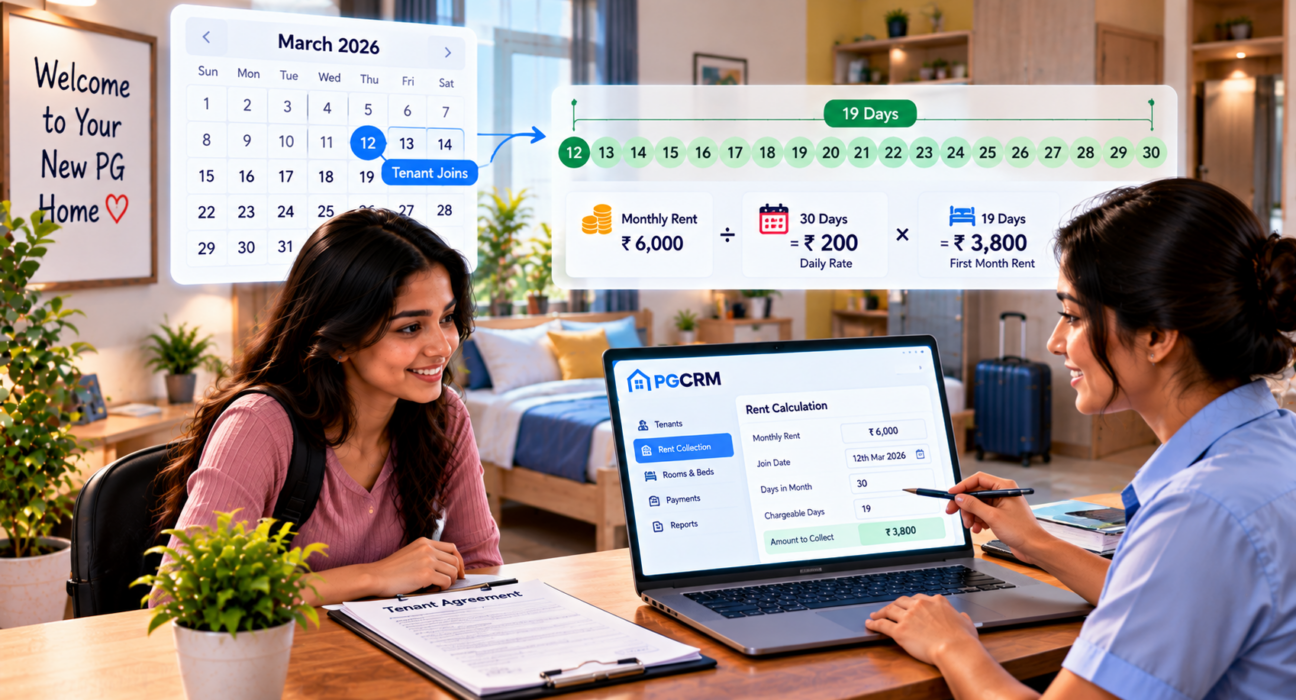
Worked example (illustrative)
This is an example, not real data. Say the monthly rent is ₹6,000 and the tenant joins on the 12th of a 30-day month.
- Daily rate: ₹6,000 ÷ 30 = ₹200
- Days stayed (12th to 30th, including the 12th): 19 days
- First month rent: 19 × ₹200 = ₹3,800
From the next month, the tenant pays the full ₹6,000.
What if the month has 31 days?
You have two choices:
- Fixed 30-day rule. Always divide by 30, whatever the month. It’s easy to remember and easy to explain.
- Actual days rule. Divide by 31 for a 31-day month. It’s more exact, but you’ll end up with odd numbers like ₹193.55 a day.
For the same tenant in a 31-day month, the second rule gives about ₹3,871 for 20 days. The difference is small, but it’s exactly the kind of small difference that starts an argument. Pick one rule and stick to it.
Decide These Policies Before the Next Tenant Joins
A lot of PG mid month billing trouble disappears when you settle these questions in advance.
Does the joining day count?
Most PGs charge for the day of arrival, since the bed is occupied from that day. Whatever you choose, apply it to everyone.
Is there a minimum first-month charge?
Some owners set a minimum, such as a fixed number of days, so a tenant who joins on the 29th isn’t billed for just two days of rent. That’s your call. Just make it clear upfront.
How do you treat the deposit?
Keep the security deposit separate from rent. Note the amount, the date and the tenant’s name. Never merge it into one payment entry. A clear deposit record makes the final settlement much easier.
What about food and other charges?
If meals, laundry or Wi-Fi are billed separately, decide whether they’re also pro-rated. Write it in your rules so nobody is surprised.
What are the late fee rules for the first payment?
State the due date for the first payment clearly, and what fine applies if it’s late. Better still, collect the first payment at the time of joining.
A Simple Move-In Checklist to Avoid Billing Errors
Print this or keep it on your phone. Go through it for every new tenant.
- Confirm the joining date and the bed or room.
- Confirm the monthly rent and the billing method (calendar month or join-date cycle).
- Calculate the first payment and show the working to the tenant.
- Collect the security deposit and record it separately.
- Record the payment as cash or UPI with the date and amount.
- Collect and store the KYC documents.
- Tell the tenant the next due date.
- Give them a receipt or a message with the details.
It takes five minutes and saves you hours of clearing up later.
Mistakes to Avoid in PG Mid-Month Billing
Changing the rules for different tenants
If you give one tenant a favour, say so and note it. Otherwise, rules by mood become rules nobody can follow.
Calculating in your head
Even simple sums go wrong when the phone is ringing, and someone is waiting at the door. Use a calculator, a sheet or an app.
Not giving a written breakdown
A line like “₹3,800 for 12th to 30th, ₹200 per day” ends most disputes before they begin.
Forgetting the last month
Mid-month issues also happen when a tenant leaves. The same rules should apply to the last month, for example, notice period, days stayed and deductions. Settle it in writing.
Mixing up rent and deposit
If your record just says “₹9,800 received”, you won’t know later how much was rent and how much was deposit.
Recording payments late
Note every payment as soon as it’s received. Memory is a poor accountant.
How to Handle Room Shifts and Mid-Month Moves
Mid-month billing doesn’t stop at joining. Tenants also change rooms, and sometimes the rent changes with them. If someone shifts from a shared room to a single room on the 15th, you need a clear way to bill the two halves of the month.
The same logic applies: work out the daily rate for each room, count the days in each, and add them up. Record the date of the shift and the new rent so the next month’s bill is right.
How PG Management Software Helps With Mid-Month Billing
Software won’t decide your policy for you, but it removes the routine calculation and record-keeping from your desk.
Using PG management software such as PGCRM can help owners keep tenant details, rent and deposits organised in one place. According to the PGCRM website, it supports:
- Monthly or join-date billing cycles with automatic invoices, which suits the two methods described above
- Rent collection by cash or UPI, with each payment recorded against a tenant
- Deposits, fines and clean refunds, so those stay separate from rent
- Room shifts, vacates and settlements for mid-month moves
- Automatic rent reminders before the due date
- Tenant records with KYC and joining date, saved along with the full stay history
Since each payment is linked to a tenant, matching cash and UPI at month-end becomes far simpler than flipping through a register.
FAQ
How do you calculate rent for a tenant who joins mid-month?
Divide the monthly rent by 30, or by the actual number of days in the month. Multiply that daily rate by the number of days the tenant will stay in that month. For example, ₹6,000 rent and 19 days gives ₹3,800. Pick one method and use it for everyone.
Should a PG charge full rent for the first month if a tenant joins mid-month?
That’s up to you. Some PGs charge a pro rata amount for the remaining days, while others use a join-date cycle where the first full month starts on the joining day. What matters is that the policy is clear, written down, and applied equally to all tenants.
What is a join-date billing cycle in a PG?
A join-date billing cycle starts on the day the tenant moves in. If they join on the 12th, rent is due on the 12th of each month. It avoids pro-rata calculations and works well for PGs with frequent move-ins and move-outs.
Should the joining day be counted for rent?
Most PGs count it, because the tenant occupies the bed from that day. There’s no fixed rule, so decide your policy and tell tenants before they join. The important thing is to be consistent for every tenant.
Should I divide rent by 30 or by the actual days in the month?
Both work. Dividing by 30 is simpler and easy to explain. Using actual days is more precise but gives uneven daily rates. Choose one and stick to it; otherwise, tenants will notice inconsistencies between months.
How do I avoid billing disputes with tenants?
Set your billing method in writing, show the calculation to the tenant at joining, and keep rent and deposit as separate entries. Record every payment the same day and share a receipt or message. Clear records settle most disagreements quickly.
Can PG software handle mid-month billing automatically?
Some PG management software supports different billing cycles and automatic invoices, which reduces manual work. Check how a tool handles first-month billing, deposits and room shifts before you commit. PGCRM lists monthly or join-date billing cycles among its features.
Conclusion
PG mid-month billing doesn’t have to be a monthly headache. Choose your method, whether that’s a pro-rata first month or a join-date cycle. Write your rules down, keep rent and deposit apart, and show every tenant their working. Do that, and most billing errors simply stop happening.
If you want tenants, billing cycles, rent, and deposits in one place, explore PGCRM to simplify PG and hostel management.