
Predictive Maintenance Software for Field Service: How It Improves Operations
Most field service teams still work the same way: a machine fails, the customer calls, and a technician rushes out. The visit is urgent, the parts may not be on the van, and the customer has already lost hours or days of productivity.
Predictive maintenance software for field service changes that sequence. It uses equipment data and service history to flag likely failures early, so the visit is planned instead of frantic.
This guide explains what predictive maintenance means in a field service context and how it improves operations. It also covers what to look for in software and how to make sure predictions turn into completed, verified jobs.
What Is Predictive Maintenance in Field Service?
Predictive maintenance is a maintenance approach that uses real-time or historical equipment data to estimate when an asset is likely to fail, so service can be scheduled before the breakdown happens.
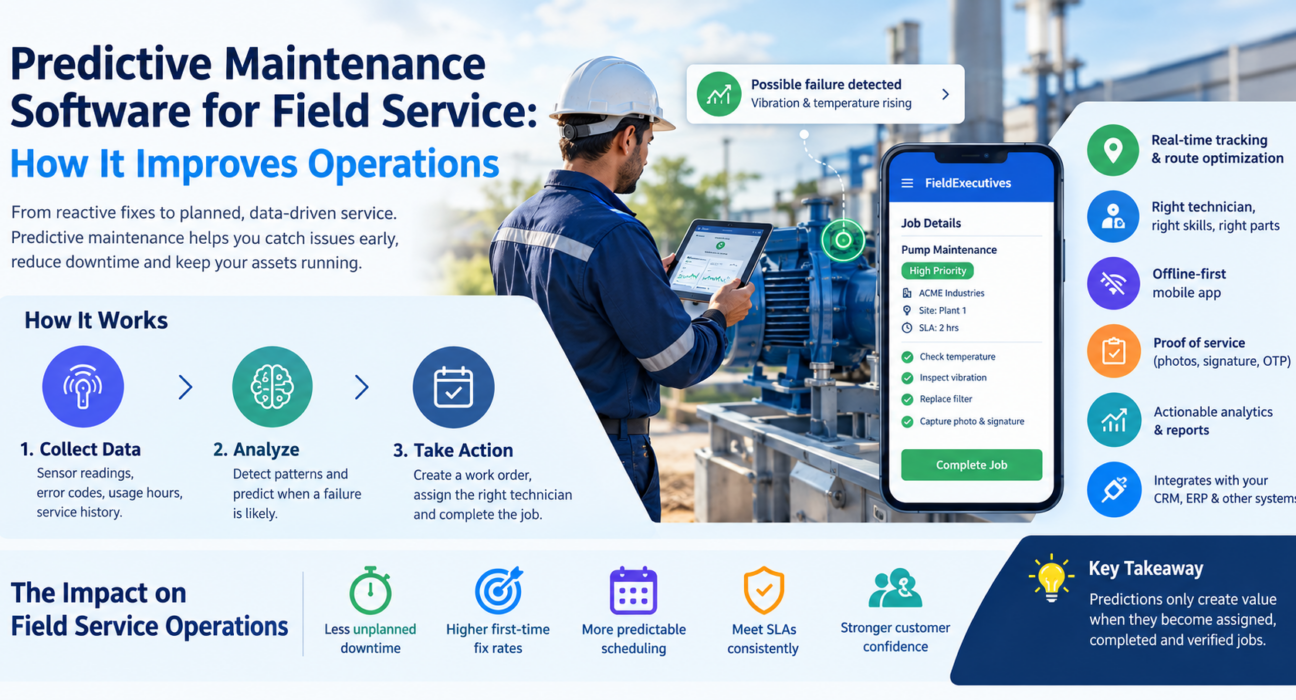
In field service, this typically involves three layers working together:
- Data collection: sensor readings, error codes, usage hours, inspection forms and past service records.
- Analysis: rules or models that detect patterns, such as rising temperature or repeated faults, that usually come before a failure.
- Action: a work order created, assigned to the right technician and completed with the right parts.
The third layer is where many programs stall. A prediction only creates value when someone acts on it.
Reactive vs Preventive vs Predictive Maintenance
| Approach | When service happens | Main weakness |
|---|---|---|
| Reactive | After the asset fails | Unplanned downtime, urgent dispatches, unhappy customers |
| Preventive | On a fixed calendar or usage schedule | Parts replaced too early, or failures between visits |
| Predictive | When data shows a failure is likely | Needs good data and a reliable execution process |
Predictive maintenance does not replace the other two entirely. Most service businesses run a mix: preventive schedules for low-risk assets and predictive triggers for critical or high-cost equipment.
How Predictive Maintenance Improves Field Service Operations
1. It Reduces Unplanned Downtime
When a fault is caught early, the repair can be scheduled at a convenient time. The customer’s equipment keeps running, and your team avoids emergency calls that disrupt the rest of the day.
2. It Improves First-Time Fix Rates
A technician who knows the likely fault and the required part before leaving is far more likely to finish the job in one visit. Return visits are among the most expensive parts of field service, so avoiding them directly protects margin.
3. It Makes Scheduling More Predictable
Reactive work arrives unpredictably, which forces dispatchers to reshuffle routes constantly. Planned, predictive work can be grouped by area, balanced across technicians and fitted into efficient routes.
4. It Helps You Meet SLAs
Service-level agreements usually specify response and resolution times. Early warnings give you time to act inside the window, instead of explaining a miss after the fact.
5. It Lowers Unnecessary Maintenance
Condition-based triggers mean assets are serviced when they need it. This can reduce visits driven purely by the calendar, though the saving depends on how well the data reflects real asset condition.
6. It Improves Customer Confidence
Customers notice when a provider contacts them before something breaks. Proactive service builds trust and strengthens renewal conversations for AMCs and service contracts.
What Predictive Maintenance Software Should Include
Not every tool marketed this way covers the full workflow. A practical evaluation checklist:
- Asset and service history: a record of each asset, past faults, parts used and visits made.
- Condition triggers: the ability to create alerts from thresholds, error codes, usage counts or inspection results.
- Automatic work order creation: an alert should become an assigned job, not just a notification.
- Skill- and location-aware dispatch: the right technician, nearby, with the right parts.
- Mobile app for technicians: job details, checklists and data capture that work even with poor network coverage.
- Proof of service: photos, signatures or OTP confirmation that the job was actually done.
- Analytics: first-time fix rate, repeat visits, SLA compliance and downtime trends.
- Integrations: APIs to connect with your ERP, CRM or asset monitoring systems.
If a tool predicts well but cannot dispatch, track and verify the work, you will need a second system to close the loop.
Why Predictions Fail Without Strong Field Execution
A prediction is only the start of the process. Here is a common failure pattern:
- An alert flags a pump or compressor as high risk.
- The alert sits in an inbox or a WhatsApp group.
- A technician is assigned late, without the right part.
- The visit happens, but there is no record of what was checked or replaced.
- The same fault returns, and nobody can see why.
The gap is rarely the data. It is the handoff from insight to completed, verified work. This is why many businesses pair their monitoring or maintenance data with field force management software that handles assignment, tracking, execution and proof.
How to Roll Out Predictive Maintenance in Field Service
A phased approach is more reliable than switching everything at once.
- Start with critical assets. Choose equipment where downtime is costly or SLA penalties are high.
- Clean up your service history. Standardize fault categories, part names and job types so patterns can be detected.
- Define trigger rules. Decide what condition creates a work order and who owns it.
- Standardize the job checklist. Make sure every visit captures the same readings and outcomes.
- Connect alerts to dispatch. Automate assignment where possible and set a response time for each priority level.
- Track a small set of metrics. First-time fix rate, repeat visits, SLA compliance, travel time per job and unplanned downtime hours are a solid starting set.
- Review monthly and refine. Adjust thresholds when you see false alarms or missed failures.
Common Challenges to Plan For
- Poor data quality: inconsistent notes and missing fault codes weaken any prediction.
- Alert fatigue: too many low-value alerts cause teams to ignore the important ones.
- Parts availability: predicting a fault does not help if the part is not in stock.
- Technician adoption: if the app is slow or complicated, data capture suffers.
- No accountability trail: without proof of work, it is hard to learn from outcomes.
How FieldExecutives Supports the Field Execution Side
FieldExecutives is a field force management platform. It is not a sensor or condition-monitoring tool, so it does not generate failure predictions itself. What it does is help manage the field work that predictions create, which is where many programs lose value.
Businesses looking to simplify these processes can use field force management software such as FieldExecutives to handle:
- Task assignment with SLAs: managers can create tasks and visits with checklists, priority levels and an SLA, and the job reaches the technician’s phone instantly. The platform also offers smart suggestions based on location and workload.
- Guided job execution: technicians follow a job card and complete a checklist, then capture photo, signature or OTP proof before a job can close.
- Offline-first mobile app: technicians can complete visits without network coverage, and data syncs when they reconnect.
- Live visibility: a real-time map shows where technicians are and what status each job is in, with SLA timers and monitoring.
- Route optimization: AI route and beat-plan optimization helps reduce travel between planned visits.
- Custom forms and workflows: teams can build inspection forms, job types and approvals without writing code, which helps standardize the data captured on every visit.
- Integrations: FieldExecutives connects with CRM, ERP, accounting and HR systems through APIs, so data can move between tools.
- Reporting: real-time KPIs help you track visit completion and SLA performance over time.
If you use a separate system for asset monitoring or maintenance planning, FieldExecutives can serve as the layer that puts those work orders in front of the right technician and records what happened. Before relying on a specific integration for your asset data, confirm the exact setup with the FieldExecutives team during a demo.
Service-focused teams can also see how the platform fits field service and repair operations or facility management rounds.
Conclusion
Predictive maintenance software for field service helps teams move from emergency repairs to planned, data-backed interventions. The benefits include less unplanned downtime, better first-time fix rates, smoother scheduling and stronger SLA performance.
The practical takeaway: predictions only matter if they become assigned, completed and verified jobs. Start with your most critical assets, standardize your data, and make sure your field team has a reliable way to execute and record every visit.