

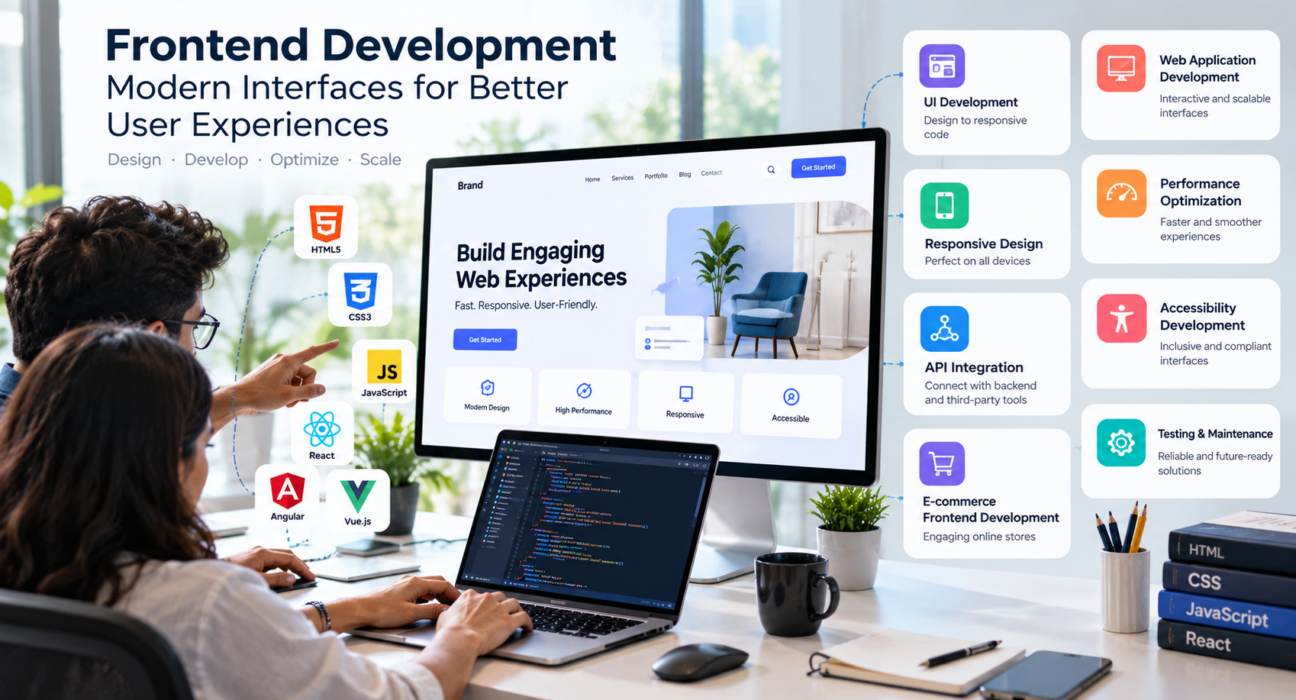
Frontend development companies build everything users see and interact with in a website or web app: layouts, navigation, forms, animations, and dashboards. Most also offer UI implementation, responsive design, performance optimization, accessibility work, API integration, testing, and ongoing maintenance.
If you’re planning a new product or redesigning an existing one, knowing what these firms actually deliver helps you scope the project, compare proposals, and avoid paying for services you don’t need. This guide covers the core services of frontend development companies, how they differ from backend and full-stack teams, and how to choose the right partner.
What Do Frontend Development Companies Do?
A frontend development company turns designs and business requirements into working, browser-based interfaces. Their code runs on the user’s device, so their work directly shapes how fast, usable, and trustworthy your product feels.
Typical work includes writing HTML, CSS, and JavaScript, building component-based interfaces with frameworks such as React, Angular, or Vue.js, and connecting the interface to backend systems through APIs. Good teams also care about how the product performs on slow networks, older devices, and assistive technologies.
Core Services Offered by Frontend Development Companies
1. UI Development and Design Implementation
This is the foundation. Developers take mockups from Figma, Sketch, or Adobe XD and build them as functional interfaces. A strong team preserves the intent of the design while handling real-world details such as empty states, error messages, and loading behavior that static mockups often skip.
Many companies also build reusable component libraries or design systems. These keep buttons, forms, and typography consistent as your product grows.
2. Custom Web Application Development
Frontend firms build interactive web applications such as SaaS dashboards, customer portals, booking platforms, and admin panels. Here the frontend does real work: managing application state, handling user input, updating data in real time, and keeping complex screens fast.
3. Single-Page Application (SPA) and Progressive Web App (PWA) Development
SPAs load once and update content dynamically, which creates a smooth, app-like experience. PWAs go further, offering offline access, push notifications, and home-screen installation without a separate mobile app. Companies offering these services typically work with modern JavaScript frameworks and service workers.
4. Responsive and Cross-Browser Development
Your users visit from phones, tablets, laptops, and large monitors, using different browsers. Frontend teams make sure layouts adapt cleanly and behave consistently across Chrome, Safari, Firefox, and Edge. This is basic hygiene, but it’s also one of the most common places where low-quality work shows.
5. Frontend Performance Optimization
Speed affects user experience and search visibility. Performance services usually include:
- Code splitting and lazy loading
- Image and font optimization
- Reducing unused JavaScript and CSS
- Improving Core Web Vitals metrics
- Caching and asset delivery strategies
If your site already exists but feels slow, a performance audit is often a smaller, cheaper engagement than a rebuild.
6. API and Backend Integration
The frontend needs data. Developers connect the interface to REST or GraphQL APIs, authentication systems, payment gateways, CMS platforms, and third-party tools. Even when a company doesn’t build the backend, it should be able to work cleanly with yours and flag issues in API design early.
7. Accessibility Development
Accessible interfaces work for people using screen readers, keyboard navigation, or other assistive tools. Frontend companies with accessibility expertise build to recognized standards such as WCAG, use semantic markup, and test with real assistive technologies. Depending on your market, accessibility may also carry legal or compliance implications, so verify the requirements that apply to you.
8. Frontend Migration and Modernization
Older products often run on outdated libraries or heavy legacy code. Frontend companies can migrate a jQuery-based interface to React, upgrade an aging Angular application, or gradually replace pieces of a legacy UI without a risky full rewrite.
9. E-commerce Frontend Development
For online stores, the frontend affects conversion directly. Services include building storefront themes, headless commerce frontends, product search and filtering, checkout flows, and mobile shopping experiences on platforms such as Shopify, WooCommerce, or custom stacks.
10. Testing, QA, and Maintenance
Reliable teams test their work through unit tests, integration tests, and end-to-end tests. After launch, many offer support retainers covering bug fixes, dependency updates, security patches, and small feature additions.
Frontend vs. Backend vs. Full-Stack Companies
| Type | Focus | Best for |
|---|---|---|
| Frontend | User interface, interactions, performance in the browser | Redesigns, UI-heavy products, teams with an existing backend |
| Backend | Databases, servers, business logic, security | Data-heavy systems, integrations, infrastructure |
| Full-stack | Both frontend and backend | New products needing one team end to end |
If you already have backend engineers or an API, a specialized frontend company can be a good fit. If you’re starting from scratch, a full-stack team may reduce coordination overhead.
Which Technologies Do Frontend Development Companies Use?
Common technologies include:
- Frameworks and libraries: React, Angular, Vue.js, Svelte, Next.js, Nuxt
- Languages: JavaScript, TypeScript, HTML5, CSS3
- Styling: Tailwind CSS, Sass, CSS-in-JS
- State management: Redux, Zustand, Pinia, NgRx
- Tooling: Vite, Webpack, Git, Storybook
- Testing: Jest, Cypress, Playwright
The best choice depends on your product, existing codebase, and hiring plans. A good company recommends a stack based on your needs rather than defaulting to whatever it prefers.
When Should You Hire a Frontend Development Company?
Hiring outside help makes sense when:
- You’re launching a web product and need a polished interface quickly.
- Your current site is slow, outdated, or hard to use on mobile.
- Your in-house team lacks specific frontend expertise.
- You need to migrate to a modern framework.
- You want an accessibility or performance audit from specialists.
- You need extra capacity for a defined project.
For long-term, core-product work, some businesses prefer building an in-house team. Others use a hybrid approach, with an agency setting up architecture and an internal team taking over.
How to Choose the Right Frontend Development Company
Follow these steps to narrow your options:
- Define your scope first. Write down your goals, target users, must-have features, timeline, and rough budget range.
- Build a shortlist. Directories and comparison platforms such as GoFirms let you research and compare frontend and web development companies by service focus, location, and other listed details.
- Review portfolios critically. Look for projects similar to yours in complexity, not just attractive screenshots. Open live products and test them on your phone.
- Ask about process. How do they handle design handoff, code review, testing, and communication? Ask who will actually work on your project.
- Check technical fit. Confirm experience with your preferred framework, your backend, and any third-party systems.
- Talk to past clients. Ask about communication, deadline handling, and how the team responded to changes.
- Compare proposals beyond price. A lower quote may exclude testing, accessibility, or post-launch support. Compare what’s included, not just the total.
Questions to Ask Before Signing
- What does your QA process look like?
- How do you approach performance and accessibility?
- Who owns the code and design assets at the end?
- What happens after launch, and what support is available?
- How do you handle scope changes?
Common Pricing Models
Frontend development companies typically price work in a few ways:
- Fixed price: Best for well-defined projects with clear requirements.
- Time and materials: Better for evolving products where scope will change.
- Dedicated team or retainer: Suited to ongoing development and long-term partnerships.
Costs vary widely based on location, team seniority, and project complexity, so request detailed quotes from several providers rather than relying on general averages.
Red Flags to Watch For
- Vague proposals that don’t break down deliverables
- No visible experience with your framework or industry type
- Portfolios full of designs but few live, working products
- No mention of testing, performance, or accessibility
- Pressure to sign quickly or skip a discovery phase
- Unclear ownership of code and assets
Frequently Asked Questions
What services do frontend development companies provide?
They provide UI development, responsive design implementation, web application development, performance optimization, API integration, accessibility work, cross-browser testing, and ongoing maintenance. Some also handle migrations, PWA development, and e-commerce storefronts. Exact offerings vary, so confirm the scope before hiring.
What is the difference between frontend and full-stack development companies?
Frontend companies specialize in what users see and interact with in the browser. Full-stack companies handle both the interface and the server-side logic, databases, and infrastructure. If you already have a backend or API, frontend specialists may suffice. For a new product from scratch, full-stack can be simpler.
Do frontend development companies also do UI/UX design?
Some do, and some don’t. Many frontend firms focus on implementing designs, while others offer design and development together. If you don’t have a designer, look for a company with in-house UI/UX capabilities, or hire a design agency separately and coordinate handoff.
How do I choose between React, Angular, and Vue?
There’s no universal winner. React offers a large ecosystem and flexibility, Angular provides a full, opinionated framework often favored for large enterprise apps, and Vue is known for a gentle learning curve. Choose based on project complexity, team skills, and long-term maintenance, and ask a prospective company to justify its recommendation.
How long does a frontend development project take?
It depends on scope. A marketing site may take a few weeks, while a complex web application can take several months. Timelines are shaped by the number of screens, integrations, design readiness, and feedback cycles. A reputable company will give a phased estimate after reviewing your requirements.
Can I hire a frontend development company for an existing website?
Yes. Many companies take on redesigns, performance fixes, migrations, and feature additions for existing products. They usually start with a code and UX audit to identify problems and recommend whether to improve, refactor, or rebuild.
Where can I find and compare frontend development companies?
You can research providers through business directories, referrals, and comparison platforms. GoFirms is one option for exploring and comparing web and frontend development companies. Whichever source you use, verify claims yourself through portfolios, client conversations, and a direct discussion of your project.
Conclusion
Frontend development companies do far more than “make things look good.” They build the interfaces people use, optimize how quickly those interfaces load, make them work across devices and for all users, and connect them to the systems behind the scenes.
To choose well, start with a clear scope, shortlist providers whose experience matches your needs, and compare proposals on process, quality, and support rather than price alone. When you’re ready to research options, you can use GoFirms to explore and compare frontend and web development companies before reaching out.