
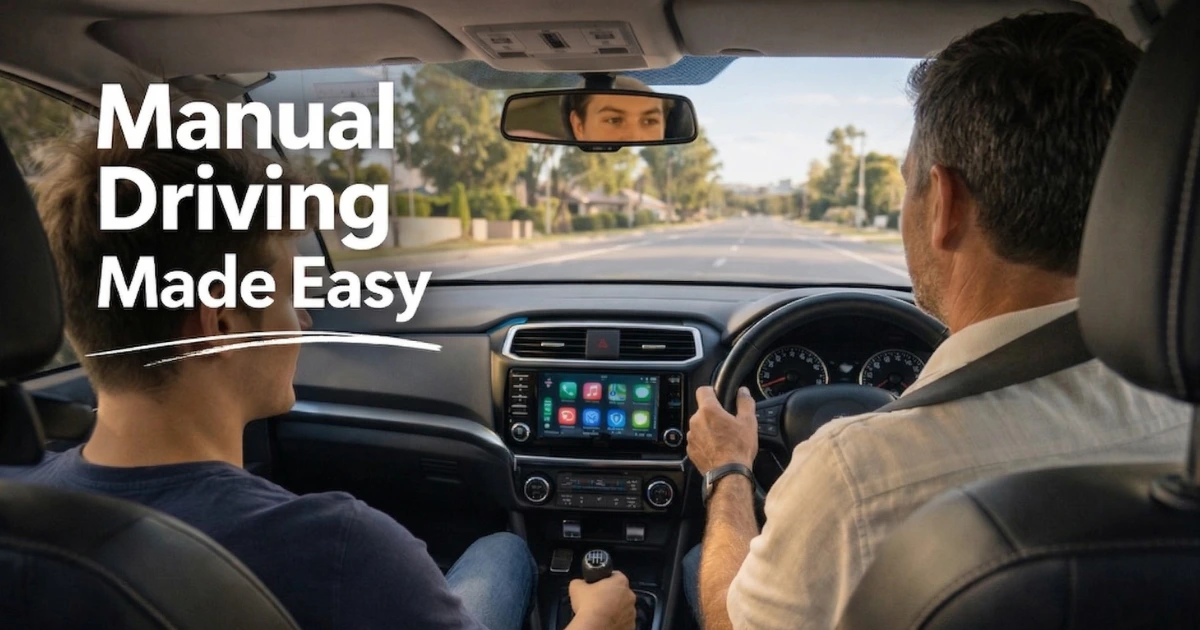
Manual driving has a reputation for being one of the most intimidating things a new driver can take on but at Trueway Driving School one of Perth’s most trusted professional driving schools, they’ve helped hundreds of beginners discover that manual driving made easy isn’t just a catchy phrase it’s a genuine outcome of the right instruction, the right technique, and the right mindset. If the gearbox has been putting you off, or you’ve tried before and found it overwhelming, this guide is going to change the way you think about manual driving permanently.
1. Why Manual Driving Feels Hard
Before we get into the how, let’s address the why because understanding what makes manual driving feel difficult is the first step to making it feel easy.
The Real Reason Manual Driving Feels Overwhelming
Manual driving asks your brain to do several things simultaneously that it has never done before: manage three pedals, operate a gear stick, read the road, follow road rules, and keep the car in the right lane all at the same time. For a brain encountering these tasks for the first time, the cognitive load is genuinely high. Anxiety, stalling, and lurching aren’t signs of failure they’re the entirely predictable result of asking your brain to process too many new things at once.
Here’s the reassuring reality: every single one of those tasks becomes automatic with repetition. Research in motor learning consistently shows that complex multi-step physical sequences driving a manual car, playing a musical instrument, learning to type transition from effortful and conscious to smooth and unconscious within a relatively small number of practice hours. The difficulty you feel at the start is not a ceiling it’s a temporary starting point.
The Analogy That Changes Everything
Think of learning to drive a manual like learning to ride a bike. The first few attempts feel chaotic and impossible too many things to balance at once. Then, somewhere in the process, it clicks. Not because the task got easier, but because your brain automated the components and freed up your attention for the overall experience. Manual driving works exactly the same way. The click is coming you just need enough quality repetitions to get there.
2. Manual Driving Made Easy: The Core Techniques That Actually Work
Great instruction breaks manual driving into manageable, learnable components. Here are the core techniques that transform the gearbox from intimidating to intuitive.
Mastering the Biting Point First
Everything in manual driving starts with the biting point the exact clutch position where the engine begins to engage the wheels and the car starts to move. If you can find and hold the biting point reliably, every other manual skill becomes significantly easier to build on top of it.
How to find it every time:
- Press the clutch all the way to the floor
- Select first gear
- Slowly raise the clutch pedal not quickly, not in a single motion
- Stop the moment you feel the car pull slightly forward or hear the engine note drop
- That’s your biting point hold it there
Practise finding the biting point with the handbrake on, in a stationary car, until it feels completely natural. This single step, done well, removes the primary source of stalling for most beginners.
The Seesaw Rule for Smooth Gear Changes
The most common cause of lurching and jerking in manual driving is an imbalance between the clutch coming up and the accelerator going down. Think of your left foot (clutch) and right foot (accelerator) as a seesaw: as one goes down, the other comes up smoothly and proportionally, not in sudden jerks.
When moving off from rest:
- Clutch down, first gear, find the biting point
- Add a small amount of accelerator enough to hear the engine engage
- Slowly raise the clutch while the accelerator stays steady
- As the clutch fully releases, continue increasing the accelerator smoothly
The smoother and slower you make this transition, the smoother the car moves. Speed is the enemy of smooth clutch control. Slow down your clutch release always more than you think you need to.
Gear Selection: Knowing When to Change
A question every manual learner asks early: when do I change gear? The general guideline for most modern cars:
| Speed (km/h) | Gear |
|---|---|
| 0–20 | 1st |
| 20–40 | 2nd |
| 40–60 | 3rd |
| 60–80 | 4th |
| 80+ | 5th (if available) |
These are starting guides, not rigid rules. As your experience grows, you’ll begin to hear and feel when the engine is ready for a change a slight straining sound when you need to go up, a sluggish response when you’ve gone up too early. Your driving instructor in Perth will help you develop this feel progressively across your lessons.
Hill Starts Made Simple
Hill starts are the manoeuvre that causes the most anxiety in manual driving lessons Perth the fear of rolling backward into the vehicle behind while juggling three controls simultaneously. Here’s the technique that makes it manageable:
- Handbrake fully on this is your safety net, not a sign of weakness
- Clutch down, first gear selected
- Find the biting point feel the car pull against the handbrake
- Add accelerator until the engine sounds engaged (around 1500–2000 RPM)
- Release the handbrake the car should hold on the hill or begin moving forward
- Ease the clutch up as you accelerate away
The handbrake is your friend on hills. Never be embarrassed to use it even experienced drivers use it in challenging hill situations. The goal is a smooth, controlled departure, not a heroic one.
3. Common Manual Driving Mistakes and the Fixes That Make Them Easy
Knowing what goes wrong and why turns frustrating mistakes into fast learning moments.
Mistake 1: Stalling at Intersections
Why it happens: The clutch came up too quickly while the car was still stationary or near stationary, causing the engine to cut out.
The fix: When approaching an intersection, press the clutch down well before you stop. Keep it pressed while stationary. When moving off, find the biting point patiently before releasing the handbrake or moving forward. Rushing the clutch is almost always the cause. Slow down your release every single time.
Mistake 2: Crunching Gears
Why it happens: The clutch wasn’t fully pressed before selecting a new gear, or was released too quickly before the gear was fully engaged.
The fix: Make sure the clutch is fully to the floor before moving the gear stick. Press it completely, not partially. Take a brief moment to ensure the gear is fully selected before beginning to release the clutch.
Mistake 3: Kangaroo-ing (Lurching Forward)
Why it happens: The clutch released too fast relative to the accelerator input, causing the car to lurch.
The fix: Remember the seesaw rule. As the clutch comes up, the accelerator goes down proportionally and smoothly. If the car lurches, the fix is always the same: more gas, slower clutch.
Mistake 4: Forgetting to Downshift When Slowing
Why it happens: Beginners often focus on braking and forget that the clutch must be pressed and a lower gear selected before the car slows to a speed below the current gear’s range.
The fix: As you approach a stop or a significant slowdown, make clutch-in and downshifting part of your braking sequence not an afterthought after you’ve already slowed. Brake, clutch, downshift, stop (or continue at the lower gear’s speed).
Mistake 5: Looking Down at the Gear Stick
Why it happens: Uncertainty about gear positions causes beginners to glance down to confirm selection.
The fix: Practise gear changes in a stationary car with your eyes closed (handbrake on, engine off) until the positions become muscle memory. Your eyes need to stay on the road gear selection must become a feel-based, not a sight-based, action.
4. Manual Driving Practice: How to Build Skills Between Lessons
Professional driving lessons Perth give you the method. Supervised practice between lessons builds the muscle memory. Here’s how to maximise both.
Targeted Practice Beats General Driving
Rather than simply driving around between lessons, make your supervised sessions targeted. After each professional lesson, ask your instructor: “What one skill should I focus on between now and next time?” Then build your practice session specifically around that skill.
If you stalled repeatedly at roundabouts in your last lesson, find a quiet roundabout and practise moving off from it ten times in a row. If hill starts are your nemesis, find a gentle slope and repeat the sequence until it becomes reliable. Deliberate, targeted practice accelerates skill development far faster than general driving.
Use Empty Car Parks for Clutch Control Drills
Empty car parks are ideal for developing manual driving fundamentals without the pressure of real traffic. Use them to practise:
- Moving off smoothly from rest, repeatedly
- Clutch-riding at slow speed across the car park
- Hill starts if the car park has a ramp
- Gear changes from 1st to 2nd and back
These low-stakes repetitions build the muscle memory that performs reliably under the pressure of real traffic conditions.
The 10-Repetitions Rule
For any manual driving skill that feels unreliable stalling, lurching, gear crunching aim to complete it successfully ten times in a row in a controlled environment before considering it consolidated. Ten successful, smooth repetitions in a quiet location build far more reliable skill than fifty inconsistent attempts in high-pressure traffic.
5. Manual vs Automatic Driving Lessons Perth: Is Manual Still Worth It?
With automatic cars increasingly common on Perth roads, it’s a fair question is learning manual still worth the extra challenge?
The Licence Flexibility Argument
A manual licence in WA covers you to drive both manual and automatic vehicles. An automatic-only licence restricts you permanently to automatic vehicles unless you later sit a separate manual assessment. For most learners, the flexibility of a manual licence is worth the additional effort, simply because it keeps all future options open.
The Vehicle Reality in Australia
While automatics are increasingly popular, a significant proportion of vehicles on Australian roads including many work vehicles, older cars, and performance cars remain manual. If you ever need to drive for work, borrow a vehicle, or travel internationally (where manual cars are far more common), a manual licence is essential.
When Automatic Driving Lessons Perth Make More Sense
That said, automatic driving lessons Perth are genuinely the right choice for some learners particularly those with physical limitations, severe driving anxiety, or no foreseeable need for a manual vehicle. The choice should always be based on your individual circumstances and long-term goals. A qualified driving instructor in Perth can help you make that call with confidence.
6. How Truewaydrivingschool Makes Manual Driving Easy for Perth Learners
When it comes to making manual driving genuinely accessible for beginners, Truewaydrivingschool has built its entire teaching approach around exactly that goal.
A Lesson Structure Designed to Remove Overwhelm
True Way Driving School teaches manual driving lessons Perth using a progressive, component-by-component approach never introducing new skills before the foundations are solid. Students start with the biting point, master slow-speed clutch control, then build to moving off, gear changes, and complex road situations in a sequence that makes every stage feel achievable rather than overwhelming.
The result is a learning experience that feels supportive and structured, not chaotic and stressful even for learners who have found manual driving difficult before.
Full-Service Driving Tuition Across Perth
- Manual driving lessons Perth step-by-step instruction for complete beginners through to test-ready standard, delivered with patience, precision, and personalised reference points
- Automatic driving lessons Perth expert automatic vehicle instruction for learners who prefer a simpler path to their licence
- Coverage across Perth suburbs local roads, local test routes, and instructors who know the specific challenges of your area
Why Perth Learners Trust Truewaydrivingschool to Make Manual Driving Easy
- Experienced, fully accredited instructors who have taught hundreds of beginners to master the manual gearbox from scratch
- High first-attempt pass rate students arrive at the WA driving test genuinely prepared, not just hopeful
- Flexible scheduling morning, afternoon, and weekend lessons to fit around study, work, and life
- Progressive, confidence-first approach every skill is built at your pace, never rushed past before it’s solid
- Patient, judgment-free environment stalling is expected, treated as a learning signal, and used to improve technique every time
If manual driving has felt hard before, a few targeted sessions with Truewaydrivingschool can genuinely change that experience because the right instruction makes all the difference.
7. Your Manual Driving Lesson Plan: From First Session to Test Day
Understanding the full journey from first lesson to test day helps you set realistic expectations and stay motivated throughout.
Phase 1: Foundations (Lessons 1–5)
The focus here is entirely on vehicle familiarity and basic clutch control:
- Finding and holding the biting point
- Moving off and stopping smoothly in a quiet environment
- First gear changes (1st to 2nd and back)
- Basic steering and road positioning on quiet streets
By the end of this phase, most learners can move through traffic on quiet roads without stalling regularly.
Phase 2: Building Competence (Lessons 6–15)
Skills expand significantly in this phase:
- All gear changes up and down the box
- Hill starts with growing reliability
- Roundabouts, intersections, and give-way scenarios
- Increasing exposure to real Perth traffic conditions
By the end of this phase, most learners are driving with growing confidence across a range of real road environments.
Phase 3: Test Preparation (Lessons 16–25)
The final phase focuses on test readiness:
- Manoeuvres: parallel parking, angle parking, three-point turns
- Test-route familiarity in your local area
- Consistency under pressure driving well even when nervous
- Final assessment preparation with your instructor
Most learners are test-ready somewhere in this range, depending on the frequency of lessons and supervised practice.
Conclusion:
Manual driving isn’t the monster it’s made out to be. With the right technique, the right instructor, and the confidence to embrace the learning process stalls, lurches, and all the gearbox that felt impossible becomes the skill you’re most proud of.
Every element of manual driving covered in this guide from biting point mastery and the seesaw rule to hill starts and targeted practice is learnable. Not just by naturally confident drivers, but by every learner who commits to quality instruction and consistent repetition.
Trueway Driving School is the driving school Perth that makes this journey structured, supported, and genuinely achievable. With expert-led manual driving lessons Perth designed for complete beginners, flexible driving lessons Perth that work around your schedule, and automatic driving lessons Perth for learners who want an alternative path Truewaydrivingschool has the expertise, the patience, and the approach to get every Perth learner licensed and confident.