
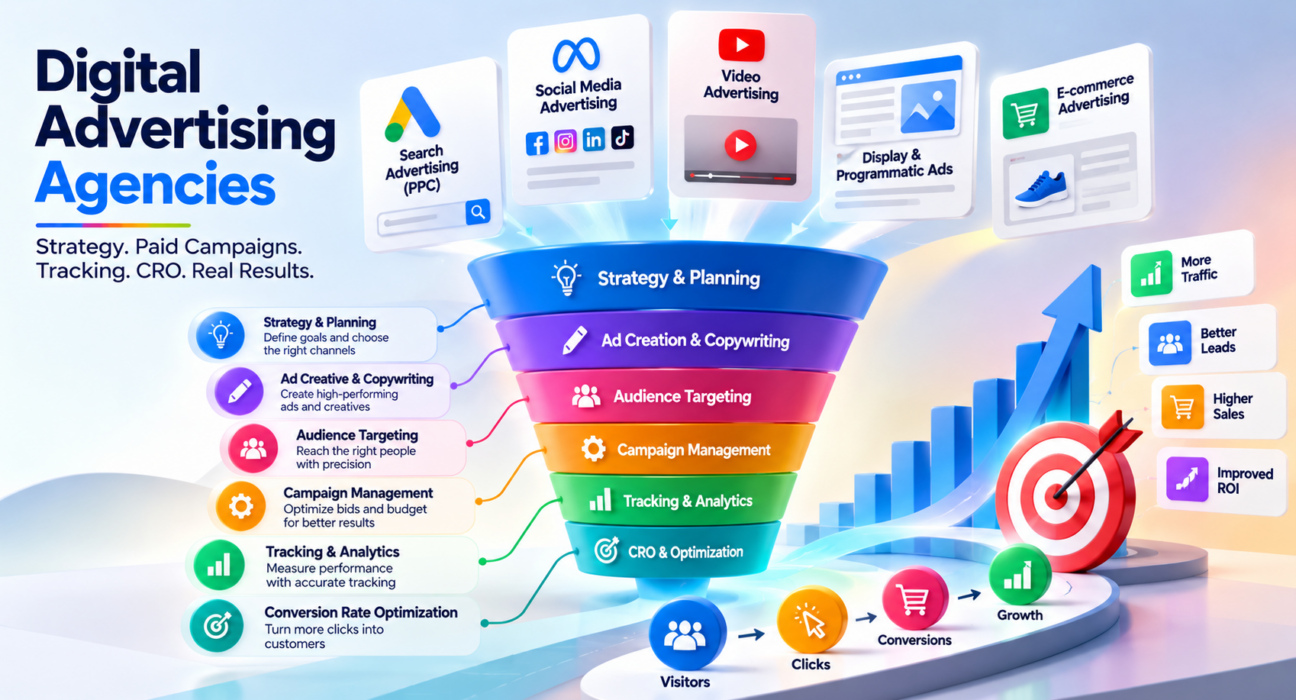
Digital advertising agencies plan, create, run, and optimize paid campaigns across online channels such as search engines, social media, video platforms, and websites. In addition, most handle audience research, ad creative, landing pages, tracking, and performance reporting. In short, they take a business goal like “get more qualified leads” and turn it into measurable ad campaigns.
If you’re a founder, marketing manager, or business owner deciding whether to hire one, the harder question is which services you need. Equally important, you should know which ones you would pay for without using. This guide breaks down what digital advertising agencies actually do, how their services differ, and how to choose a partner that fits your goals.
What Is a Digital Advertising Agency?
A digital advertising agency is a company that manages paid promotion for brands across online platforms. Unlike a general marketing agency, its core focus is paid media: ads you pay for, whether per click, per impression, or per action.
Therefore, it helps to separate it from related agency types:
- Digital marketing agencies cover a wider range, including SEO, content, email, and social media management, often alongside paid ads.
- SEO companies focus on earning organic traffic rather than buying it.
- Creative agencies focus mainly on branding and campaign concepts, so they may not manage media buying.
In practice, however, the lines blur. Many digital advertising agencies offer some organic services, and many marketing agencies run paid campaigns. What matters most is whether paid media is a core strength.
Core Services Digital Advertising Agencies Provide
1. Advertising Strategy and Planning
Good campaigns start before any ad goes live. For this reason, agencies typically begin by:
- Defining campaign goals (leads, sales, app installs, brand awareness)
- Researching your market, competitors, and customers
- Choosing which platforms fit your audience
- Setting budgets and expected targets
- Building a testing roadmap
This is where an experienced agency earns its fee. After all, a weak strategy wastes budget no matter how polished the ads look.
2. Search Engine Advertising (PPC)
Search advertising places your ads in front of people actively searching for what you sell. Agencies handle keyword research, ad copywriting, bid management, negative keyword lists, and ongoing optimization. Because buyer intent is high, this is often the first channel to test for software vendors, local services, and B2B companies.
3. Social Media Advertising
Social platforms let you target people by interests, job roles, behavior, and demographics. As a result, agencies can manage campaign setup, audience segmentation, creative testing, and budget allocation across platforms like Meta, LinkedIn, TikTok, and X. Note that this is paid social advertising, which is separate from organic social media management.
4. Display and Programmatic Advertising
Display ads appear as banners and other formats across websites and apps. Meanwhile, programmatic buying automates the purchase of ad space using audience data. Agencies use these channels mostly for awareness and retargeting, which means reaching people who have already visited your site.
5. Video Advertising
Video ads run on platforms like YouTube, social feeds, and connected TV. In some cases, agencies produce the video, adapt it to different formats, and manage targeting and spend. Video is useful for explaining complex products. However, it needs stronger creative than most other formats.
6. Remarketing and Retargeting
Most visitors don’t convert on their first visit. Remarketing campaigns therefore bring them back with relevant ads based on what they viewed or did. Agencies set up audience lists, frequency limits, and tailored messaging, so people don’t see the same ad repeatedly.
7. E-commerce and Shopping Advertising
For online stores, agencies manage product feeds, shopping campaigns, and marketplace ads. Additionally, they handle catalog optimization, which strongly affects how products appear and perform in ads.
8. Ad Creative and Copywriting
Agencies often produce or guide:
- Ad headlines and descriptions
- Static images and graphics
- Short-form video
- Landing page messaging
- A/B test variations
Before you sign, ask whether creative is included in the fee or billed separately. Otherwise, it can become one of the most common sources of surprise costs.
9. Landing Page and Conversion Rate Optimization (CRO)
Even great ads fail if the page they lead to is slow, confusing, or off-message. For that reason, many agencies design or recommend landing page improvements and test elements like headlines, forms, and calls to action. If your agency doesn’t offer this, you’ll need a web or UI/UX partner to cover it.
10. Tracking, Analytics, and Reporting
This service often separates strong agencies from weak ones. It includes:
- Setting up conversion tracking and tag management
- Connecting ad platforms to analytics tools and your CRM
- Building dashboards
- Providing regular reports with clear insights, not just raw numbers
Ultimately, you should be able to see which campaigns produce actual business results, not just clicks.
11. Campaign Optimization and Budget Management
Launching is only the beginning. After launch, agencies monitor performance, adjust bids, pause weak ads, scale winners, and shift budget between channels. Be sure to ask how often this happens and who is responsible for it.
Quick Comparison: Common Services at a Glance
| Service | Main Goal | Best For | Typical Question to Ask |
|---|---|---|---|
| Search ads (PPC) | Capture existing demand | Lead generation, local and B2B services | How do you handle keyword strategy? |
| Paid social | Build awareness and generate leads | Consumer brands, B2B targeting | How do you test creative? |
| Display/programmatic | Awareness and retargeting | Brands with longer sales cycles | How do you control placements? |
| Video ads | Storytelling and brand recall | Products needing explanation | Do you produce the video? |
| Remarketing | Re-engage past visitors | Any site with steady traffic | How do you limit ad fatigue? |
| Shopping ads | Sell products directly | E-commerce stores | Do you manage product feeds? |
| CRO/landing pages | Improve conversion rates | Businesses with traffic but weak results | Is this included or extra? |
Additional Services Some Agencies Offer
Not every agency provides the following services, so confirm before signing:
- SEO and content marketing to support paid efforts
- Email and marketing automation
- Influencer and creator partnerships
- Mobile app install campaigns
- Marketing analytics consulting
- Brand strategy and positioning
- Account-based advertising (ABM) for B2B companies targeting named accounts
How to Know Which Services You Actually Need
Not every business needs every service. Instead, match services to your situation:
- Startups testing a new product: Focus on search ads, one social channel, and solid tracking. Keep the scope small until you find what works.
- E-commerce brands: Prioritize shopping ads, remarketing, and creative testing.
- B2B and software companies: Look at search, LinkedIn-style targeting, and landing page optimization tied to your CRM.
- Local service businesses: Local search ads and clear conversion tracking usually come first.
- Established brands scaling up: Add programmatic, video, and cross-channel measurement.
As a general rule, start with the channel closest to a purchase decision. Then expand once you can prove returns.
How to Choose a Digital Advertising Agency
Step 1: Define Your Goal and Budget
First, be specific. “More sales” is vague, whereas “20 qualified demo requests a month at a target cost per lead” gives an agency something to work toward.
Step 2: Check Relevant Experience
Next, look for experience in your industry or with similar business models. Ask for case studies and, where possible, speak to past clients.
Step 3: Ask About Process and Reporting
Then find out who will manage your account, how often you’ll receive reports, and which metrics they track. Be wary of agencies that talk only about impressions and clicks.
Step 4: Understand the Pricing Model
Agencies commonly charge a flat monthly fee, a percentage of ad spend, hourly rates, or a hybrid. Because models differ, confirm what’s included (creative, landing pages, reporting) and what costs extra. Also ask whether ad spend is billed separately from agency fees, since it usually is.
Step 5: Compare Multiple Providers
Don’t decide after one call. Instead, shortlist a few agencies and compare their services, specialties, and approach side by side. For example, directories such as GoFirms can help you research and compare digital marketing and advertising providers in one place. This makes building a shortlist faster before you start conversations.
Step 6: Start With a Clear Scope
Finally, many businesses begin with a three- to six-month engagement with defined goals. They then review results before committing further.
Red Flags to Watch For
Some warning signs appear early in the conversation. Specifically, watch for:
- Guaranteed results or rankings
- No clear explanation of how your budget will be spent
- Reluctance to share account access or reporting
- Long contracts with no performance review points
- Vague answers about who actually does the work
- Reporting focused on vanity metrics
Pros and Cons of Hiring an Agency
Before you decide, weigh both sides.
Pros
- Access to specialized skills across several platforms
- Faster setup than building an in-house team
- Experience from managing many accounts
- Flexible scaling up or down
Cons
- Ongoing fees on top of ad spend
- Less day-to-day control than an in-house team
- Variable quality between agencies and account managers
- Time needed for the agency to learn your business
Hiring in-house can make sense once ad spend and complexity grow. Even then, many companies keep an agency for specialized channels.
Frequently Asked Questions
What do digital advertising agencies do?
Digital advertising agencies plan, launch, manage, and optimize paid online campaigns. Their work usually includes strategy, audience targeting, ad creation, bid and budget management, conversion tracking, and reporting. Overall, the goal is to turn your advertising budget into measurable outcomes such as leads, sales, or brand awareness.
What is the difference between a digital advertising agency and a digital marketing agency?
A digital advertising agency focuses mainly on paid media, such as search, social, and display ads. In contrast, a digital marketing agency covers a broader mix, often including SEO, content, email, and social media management. Since some agencies offer both, check which services are their core strengths.
How much do digital advertising agencies charge?
Pricing varies widely based on scope, platforms, and agency experience. Common models include flat monthly retainers, a percentage of ad spend, and hourly or project-based fees. Ad spend is usually separate. Therefore, request detailed quotes from several agencies and compare exactly what each includes.
Do digital advertising agencies create the ads too?
Many do, including copywriting, graphics, and video, but it depends on the agency and package. For example, some include creative in their fee, while others charge separately or expect you to supply assets. Ask this early so you understand total costs and who owns the final creative.
How long does it take to see results from digital advertising?
Some channels, like search ads, can generate traffic within days of launching. However, meaningful performance data and optimization usually take several weeks to a few months, because campaigns need time to gather data and be tested. Results also depend on budget, competition, offer, and landing page quality.
Should small businesses hire a digital advertising agency?
It can make sense if you lack the time or expertise to manage campaigns well. In particular, small businesses often benefit from a focused scope, such as one or two channels with clear tracking. If budgets are very limited, however, starting with a smaller engagement or learning the basics in-house first may be more practical.
How do I find a reliable digital advertising agency?
Start by defining your goals and budget, then shortlist agencies with relevant experience. Next, review case studies, ask about reporting and pricing, and speak to references. In addition, platforms like GoFirms can help you research and compare providers before you reach out.
Conclusion
Digital advertising agencies provide far more than “running ads.” At their best, they combine strategy, targeting, creative, tracking, and ongoing optimization into a system that connects ad spend to real business outcomes. Therefore, the key is knowing which services match your stage and goals, then choosing a partner that is transparent about process, pricing, and reporting.
To begin, define what success looks like and shortlist a few candidates. After that, compare them on experience, services, and communication. When you’re ready to build that shortlist, you can research and compare digital marketing and advertising companies on GoFirms to find providers that fit your needs.