
Enterprise software projects follow a predictable pattern. Initial phases proceed smoothly. Design reviews generate enthusiasm. Prototype demonstrations impress stakeholders. User interface development stays on schedule. Everyone feels confident about delivery.
Then the project hits the integration phase and everything changes. Timelines slip. Budgets expand. Technical problems emerge that nobody anticipated. Teams discover that systems they assumed would work together don’t actually communicate properly. Data that should flow seamlessly between applications requires extensive transformation. Features that worked perfectly in isolation fail when connected to production systems.
This pattern is common enough that experienced technology leaders recognize it immediately. Yet organizations continue to structure projects as if integration is a straightforward technical task rather than the most complex and risk-prone phase of enterprise software delivery.
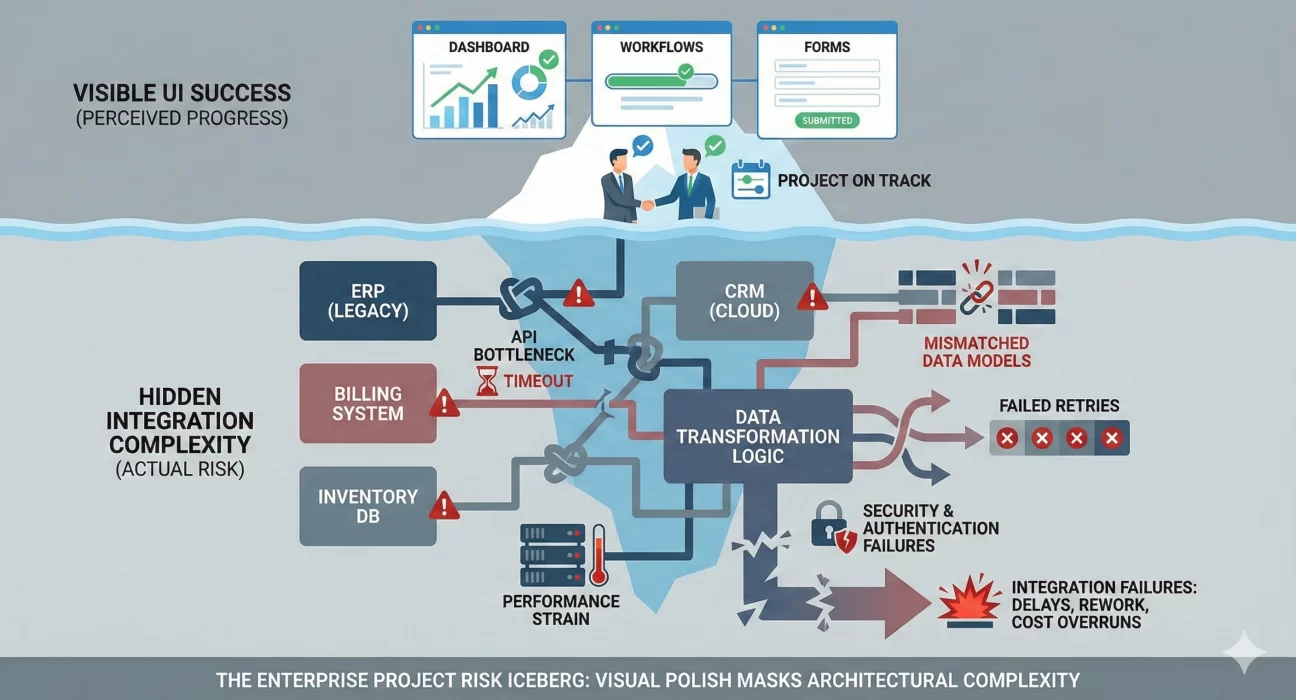
The reason is simple. Integration work is invisible until you’re in the middle of it. User interfaces are tangible. You can see them, test them, and demonstrate them to stakeholders. Integration happens behind the scenes. By the time problems become visible, you’re too far into the project to make fundamental changes without significant cost and delay.
Why Integration Looks Simple Until You Start
Integration challenges don’t appear in early project planning because the assumptions underlying those plans are overly optimistic. Project teams assume that documented APIs work as described, that data structures are consistent across systems, that network connectivity is reliable, and that existing systems can handle additional load.
These assumptions are rarely accurate. APIs might be documented but they often have undocumented limitations, edge cases, and behaviors that only become apparent under actual usage. The documentation might be outdated. Rate limits might be lower than specified. Error handling might not work as expected.
Data inconsistency is almost universal across enterprise systems. The same business entity appears differently in different systems. Customer records in your CRM don’t match customer records in your billing system. Product identifiers in your inventory system don’t align with product codes in your order management platform. Dates are formatted differently. Required fields vary. Business rules about data validity differ.
These inconsistencies remain hidden until you actually try to move data between systems. Then you discover that what looked like a straightforward data mapping exercise requires complex transformation logic, business rule reconciliation, and exception handling for cases where data simply doesn’t match.
Network reliability becomes critical when systems need to communicate in real time. Connections that work perfectly in testing encounter problems in production. API calls that complete quickly during development time out under load. Systems that respond instantly when accessed individually become slow when queried as part of automated workflows.
Existing system capacity is another common source of integration failure. Legacy systems often operate close to their performance limits. Adding integration traffic pushes them beyond sustainable load. Database queries that support current usage become bottlenecks when new systems start requesting data. Batch processes that complete successfully in their current schedule fail when integration activities compete for the same resources.
None of these problems are unusual. They’re standard challenges in enterprise integration work. But they don’t become visible until teams are deep into implementation, at which point addressing them requires significant rework.
The Real Cost of Integration Problems
When integration issues surface late in projects, the financial impact extends beyond immediate remediation costs. Projects miss committed delivery dates, which creates business opportunity costs. Planned benefits get delayed. Dependencies cascade to other initiatives. Leadership loses confidence in technology delivery capability.
Budget overruns from integration problems are typically substantial. The work required to solve integration challenges wasn’t included in original estimates. Teams need specialists who weren’t part of initial staffing plans. Testing cycles extend as problems get identified and fixed. What was planned as a six-month project becomes a twelve-month project with corresponding cost increases.
The technical debt created by rushed integration work compounds over time. When projects are under pressure to deliver, teams implement workarounds rather than proper solutions. Manual data reconciliation processes get established as temporary measures but become permanent. Data quality issues get ignored because fixing them would delay launch. System performance problems get accepted because optimization would require additional work.
These shortcuts create ongoing operational costs. Manual processes require staff time. Data quality problems cause business errors. Performance issues limit system utility. The technical debt eventually requires remediation, but by then the cost is higher because you’re fixing problems in production systems while maintaining business continuity.
User adoption suffers when integration problems persist into production. Systems that don’t reliably exchange data require users to work around the problems. Information that should be automatically available needs to be manually entered. Workflows that should be automated remain manual. Users lose trust in the system and revert to previous tools and processes.
The strategic impact is often the most significant but least visible cost. When integration problems prevent systems from working together properly, the business capabilities you were trying to enable don’t materialize. The transformation you were pursuing doesn’t happen. The competitive advantages you were seeking don’t emerge. The project delivers software but not business value.
Where Integration Complexity Hides
Integration complexity concentrates in areas that aren’t visible during initial project phases. Data transformation logic is one of these hidden complexity areas. Moving data between systems requires understanding the business meaning of that data, not just the technical field mappings.
A customer address in one system might be a single text field. In another system it might be structured into separate fields for street, city, state, and postal code. Transforming between these formats requires parsing logic that handles variations in how people enter addresses. Some addresses include apartment numbers, some don’t. Some use abbreviations, some spell out words. The transformation logic needs to handle all these cases reliably.
Error handling and recovery create another layer of hidden complexity. When integration processes fail, they need to fail gracefully without corrupting data or leaving systems in inconsistent states. Failed transactions need to be logged, retried when appropriate, and escalated to human operators when automatic recovery isn’t possible. These scenarios need to be designed, implemented, and tested even though they represent edge cases that might rarely occur.
Security and authorization add complexity that often isn’t fully scoped during planning. Different systems have different security models. Service accounts need to be created with appropriate permissions. Authentication mechanisms need to work across system boundaries. Data encryption requirements need to be satisfied. Audit logging needs to capture who did what across multiple systems.
Performance optimization becomes necessary when integration volumes scale beyond initial testing. Queries that work fine for hundreds of records become unacceptably slow for millions of records. API calls that complete quickly for individual requests need batching logic for bulk operations. Caching strategies become essential to avoid overwhelming source systems with redundant requests.
All of this work is essential for integration to function properly in production. But it’s difficult to scope accurately during initial planning because the specific requirements only become clear during implementation.
How Ozrit Reduces Integration Risk
Ozrit has delivered enterprise projects where integration complexity exceeded initial expectations but projects still delivered on time and budget because integration challenges were addressed systematically rather than discovered late.
The approach starts with comprehensive discovery focused specifically on integration requirements. Ozrit’s senior solution architects conduct detailed technical assessments of every system that needs to integrate with the new application. This includes reviewing actual API implementations, not just documentation. Testing connectivity under realistic conditions. Understanding current system load and capacity. Identifying data inconsistencies that will require transformation logic.
This discovery work happens before development starts, not after. The output is detailed integration specifications that make complexity visible upfront. Project estimates include realistic time and resource allocation for integration work. Risks get identified when there’s still time to address them through architecture decisions rather than expensive workarounds.
Ozrit’s integration teams include engineers who specialize in enterprise integration patterns and have experience with the specific systems common in enterprise environments. These specialists understand the edge cases and failure modes that affect different enterprise platforms. They know which documented features actually work reliably and which have hidden limitations. They bring pattern libraries of integration solutions that have been proven in production environments.
The development approach prioritizes integration work early in project timelines rather than treating it as a final phase. Integration architecture gets implemented first and tested thoroughly with realistic data volumes before user interface development is complete. This approach surfaces problems when there’s time to solve them properly rather than discovering them during user acceptance testing.
Testing for integration follows comprehensive protocols that go beyond happy path scenarios. Tests include failure scenarios, performance testing under load, data quality validation, and end-to-end workflows across all integrated systems. Ozrit maintains dedicated integration testing environments that mirror production system configurations, allowing problems to be identified in controlled settings before production deployment.
Project timelines for enterprise applications with substantial integration requirements typically run eight to fifteen months. Ozrit structures these timelines to accommodate the iterative nature of integration work. Initial integration implementations get tested, refined based on findings, and retested before moving to production. This approach takes longer than aggressive schedules that assume integration will proceed smoothly, but it results in systems that actually work when deployed.
Post-launch support includes dedicated focus on integration layer monitoring and maintenance. Ozrit provides 24/7 support with engineers who understand the integration architecture and can diagnose problems that span multiple systems. When integration issues occur in production, response time matters because these problems often affect critical business processes. Having specialists available who can quickly identify whether problems originate in the integration layer or in connected systems significantly reduces resolution time.
The Organizational Challenge
Technical challenges in integration are solvable with appropriate expertise and methodology. The organizational challenges are often more difficult because they require coordination across teams that have different priorities and operate under different management structures.
Integration projects typically require access to systems owned by different parts of the organization. Getting that access, understanding how those systems operate, and coordinating testing require cooperation from teams who have their own priorities. The application you’re building might be critical to your initiative, but it’s just one more request for teams managing existing enterprise systems.
These coordination challenges slow integration work regardless of technical capability. Waiting for access to test environments. Scheduling time with subject matter experts who understand legacy system behavior. Getting approval for configuration changes in production systems. These dependencies are hard to predict during planning and difficult to accelerate during execution.
Successful integration projects include explicit workstreams focused on organizational coordination. Project managers who maintain relationships with system owners. Regular coordination meetings that surface dependencies early. Executive sponsorship that can resolve conflicts when teams have competing priorities.
Technology teams can’t solve these organizational challenges independently. They require business leadership engagement and recognition that integration success depends on cross-functional cooperation.
Making Integration Risk Manageable
Integration will always involve uncertainty because you’re connecting systems that evolved independently and weren’t designed to work together. The goal isn’t to eliminate integration risk but to make it manageable through systematic approach and appropriate expertise.
The starting point is treating integration as a first-class project component rather than a technical task. Integration requirements need detailed analysis during planning. Integration architecture needs senior technical review. Integration work needs realistic time allocation in project schedules. Integration specialists need to be part of project teams from the beginning.
The next requirement is making integration complexity visible early through comprehensive discovery and proof-of-concept work. Finding problems during planning costs less than finding them during deployment. Demonstrating that systems can actually communicate reliably provides confidence that estimates are realistic.
The final requirement is having teams with genuine integration expertise, not general developers working on integration for the first time. Enterprise integration involves patterns, practices, and technical knowledge that comes from experience. Projects staffed with experienced integration specialists encounter fewer surprises and resolve problems faster when they do occur.
Organizations that approach integration with this level of seriousness deliver projects that work when deployed. Those that treat integration as straightforward technical work consistently encounter problems that delay delivery and compromise functionality. The difference in outcomes isn’t about individual technical capability. It’s about recognizing where project risk actually concentrates and structuring delivery approaches accordingly. Integration is where enterprise projects succeed or fail, and treating it as such from the start is what separates successful technology initiatives from expensive disappointments.