

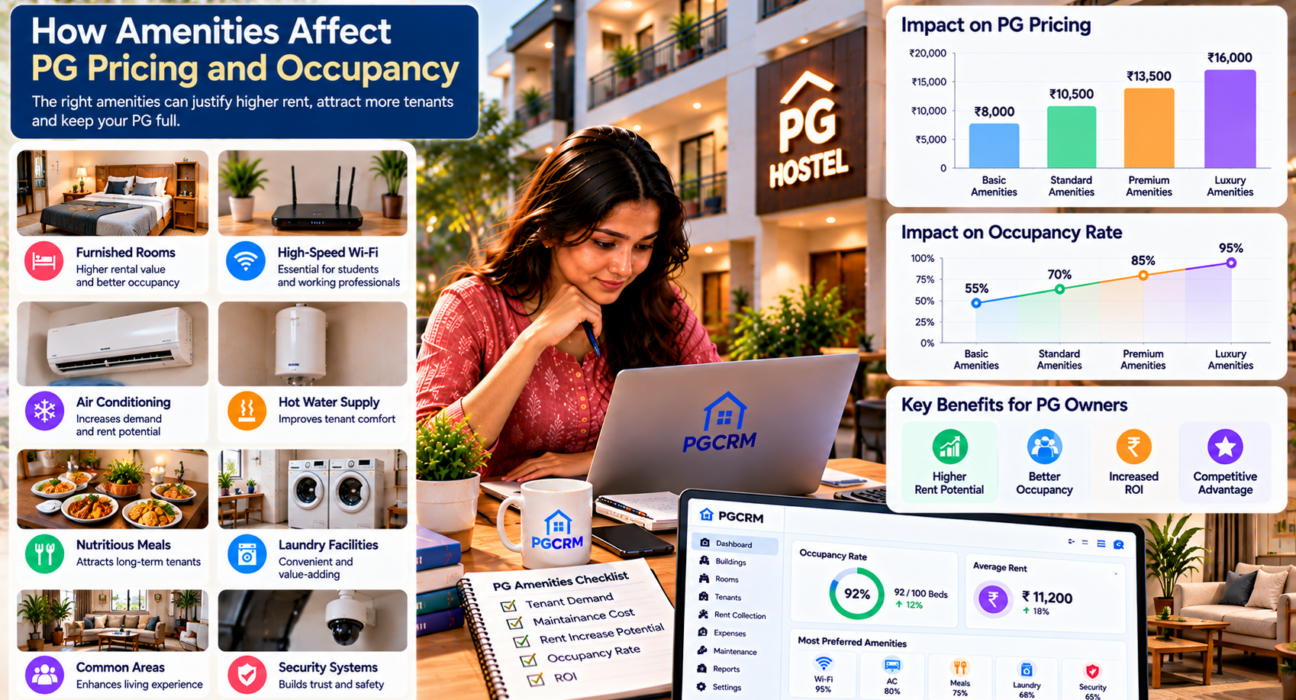
You add an AC to a few rooms and raise the rent by a thousand rupees. Two beds stay empty for a month. Or you add nothing, hold your price and watch a nearby PG with the same rent but better facilities fill up faster. Either way, the same question comes up: how much is an amenity really worth, and what does it do to occupancy?
PG amenities pricing sits between two risks. Charge too little and you give away value. Charge too much and beds stay empty. This guide shows how amenities influence rent and occupancy, how to price them, and how to test the result with a worked example. A notebook is enough to run the numbers, and PG and hostel management software helps you track what happens afterwards.
How Do Amenities Affect PG Rent and Occupancy?
Amenities affect PG pricing and occupancy in three ways: they let you charge a higher rent, they help beds fill faster, and they keep tenants from leaving. Most amenities do one of these well and the others weakly. The right price is the one that earns more rent without pushing occupancy down by more than the extra income is worth.
That last part is the one owners tend to miss. A higher rent only helps if enough tenants still say yes.
Different Amenities Do Different Jobs
Not every amenity earns its keep the same way. It helps to ask what job each one does.
| Job | What it does | Typical examples (varies by market) |
|---|---|---|
| Rent lifters | Tenants will pay noticeably more for them | AC, attached bathroom, single occupancy, a better room size |
| Occupancy protectors | Missing them loses tenants, but having them doesn’t raise rent | Reliable water and power, clean bathrooms, working locks, decent beds |
| Retention builders | Keep tenants longer and cut vacancy gaps | Stable Wi-Fi, quick repairs, clean common areas, good food |
| Marginal extras | Little effect on price or filling | Decorative items, extra lounge furniture |
This is general guidance, not data. In some areas Wi-Fi is a rent lifter, in others it’s expected. Check your own market.
The takeaway: price the rent lifters, protect with the occupancy protectors and don’t expect the marginal extras to pay for themselves.
The Price-Occupancy Trade-Off
Here’s the arithmetic that most pricing decisions skip. Raising rent increases income per bed, but each extra rupee only counts if you don’t lose too many occupied beds.
Break-even occupied beds = current occupied beds × old rent ÷ new rent
This tells you how many beds you can afford to lose after a price rise before you’re worse off.
A Worked Example
These numbers are made up to show the method. Use your own.
A PG has 30 beds at ₹6,500 rent and runs at 85% occupancy, so about 25.5 beds are occupied on average. You add an amenity and raise rent by ₹1,000 to ₹7,500.
| Scenario | Rent | Occupancy | Occupied beds | Monthly rent income |
|---|---|---|---|---|
| Today | ₹6,500 | 85% | 25.5 | ₹1,65,750 |
| Rise, occupancy holds | ₹7,500 | 85% | 25.5 | ₹1,91,250 |
| Rise, occupancy dips | ₹7,500 | 75% | 22.5 | ₹1,68,750 |
| Rise, occupancy drops further | ₹7,500 | 70% | 21 | ₹1,57,500 |
The break-even is 25.5 × ₹6,500 ÷ ₹7,500, which is about 22.1 beds, or roughly 74% occupancy. Fall below that, and the price rise loses you money even before counting what the amenity costs.
Now add the running cost. If the amenity costs ₹10,000 a month to run, the 75% scenario drops to ₹1,58,750, about ₹7,000 below where you started. The price rise looked fine on paper and failed in practice.
The lesson is simple. Before raising rent for an amenity, work out your break-even occupancy, then ask honestly whether you can stay above it.
How to Price an Amenity Step by Step
- Know your baseline. Record current rent, occupancy and average vacancy gap before changing anything.
- Work out the real monthly cost per bed. Include purchase cost spread over its life, electricity, servicing and replacement.
- Check what comparable PGs charge. Look at similar PGs in your area with and without the amenity, and note their rent gap.
- Set a premium that clears your cost with room to spare. The premium should cover the cost per bed and still look fair next to competitors.
- Calculate your break-even occupancy. Use the formula above.
- Test before rolling out. Apply it to one floor or a few rooms first.
- Review after two or three months. Compare occupancy, rent and move-outs against your baseline, then decide whether to expand, adjust or drop it.
Three Ways to Structure Amenity Pricing
You don’t have to bake everything into one rent figure. There are three common approaches.
| Structure | How it works | Works best when | Watch out for |
|---|---|---|---|
| Bundled in rent | Amenity is included for everyone | Most tenants want it, it’s cheap to run | You can’t see whether anyone values it |
| Premium room types | Rooms with the amenity cost more | Only some tenants want it, like AC rooms | Premium rooms can sit empty if priced too high |
| Optional paid add-ons | Tenants opt in and pay extra, such as laundry | Use is uneven and costs scale with use | Billing and tracking take extra effort |
Many PGs mix all three: a solid base package, a few premium room types and a couple of optional extras.
An Illustrative Price Ladder
Premium room types let tenants choose their level instead of forcing one price on everyone. A simple ladder might look like this (example figures only):
| Room type | Illustrative rent |
|---|---|
| Triple sharing, basic | ₹5,500 |
| Double sharing | ₹6,500 |
| Double sharing, attached bathroom | ₹7,500 |
| Single room with AC | ₹11,000 |
The gaps between steps should reflect the real extra cost and what tenants in your area will pay, not just round numbers.
How Amenities Affect Occupancy, Not Just Price
Rent is only half the picture. Amenities also change how fast and how long beds stay full.
- Faster filling. Some amenities shorten the time between one tenant leaving and the next one joining, which reduces vacancy loss.
- Longer stays. Reliable basics and quick repairs keep tenants from moving out over small frustrations.
- Fewer complaints. Fixing common pain points reduces friction and the cost of turnover.
- Better word of mouth. Satisfied tenants recommend your PG, which can lower the effort of finding new ones.
Retention often matters more than rent. A tenant who stays an extra three months saves you the empty days and the cleaning and marketing effort of finding a replacement. An amenity that doesn’t raise rent can still pay for itself this way.
Mistakes in PG Amenities Pricing
- Setting the premium by guesswork. Compare with real local rates and your own break-even.
- Raising rent across the board for an amenity only some tenants use.
- Ignoring running costs. A ₹1,000 premium that costs ₹900 to deliver barely helps.
- Pricing above the market without offering something visibly better.
- Changing price and amenities at once, so you can’t tell which caused the result.
- Not measuring. If you don’t track occupancy before and after, you won’t know whether it worked.
- Neglecting basics. Premium features don’t make up for poor water, power or cleanliness.
Tracking What Actually Happened
Pricing decisions are easier when you can see the results. You want a clear view of occupied beds, rent income, expenses and complaints, before and after the change.
PGCRM, for example, shows which beds are full, free or under repair, and provides occupancy, income and expense reports. You can also record expenses by category and building, so the running cost of an amenity doesn’t get lost, and log complaints with a priority and status trail to see whether a change helped or caused problems. See the details on the PGCRM features page.
It won’t tell you what price to set. That’s your call. It just makes sure you’re judging the result with real numbers.
Frequently Asked Questions
How much extra rent can I charge for amenities in a PG?
There’s no standard figure. It depends on your location, tenant type and what nearby PGs charge for the same amenity. A good starting point is your cost per bed plus a fair margin, checked against local rates. Then test on a few rooms and watch occupancy before applying it widely.
Do amenities increase PG occupancy?
They can, but not all of them do. Basics like clean water, power and safe locks protect occupancy by preventing tenants from leaving. Features like Wi-Fi and prompt repairs can speed up filling and improve retention. Extras with little demand rarely change occupancy. Track your own numbers to see which ones matter.
Should I include amenities in rent or charge separately?
Include amenities that most tenants expect and that cost little to run. Charge separately, through premium rooms or optional add-ons, for features only some tenants want or whose cost rises with use, such as AC or laundry. Separate pricing also shows you which amenities tenants truly value.
How do I know if my PG rent is too high?
Watch for beds staying empty longer than usual, tenants citing price when they leave and prospects comparing you unfavorably with nearby PGs. Then check your break-even occupancy. If your occupancy is falling toward that level after a price rise, the increase is probably costing you more than it earns.
Is it better to charge higher rent with fewer tenants or lower rent with a full PG?
It depends on your costs and numbers. Calculate total rent income at each combination of price and occupancy, then subtract running costs. A fuller PG at a lower price often wins because fixed costs stay the same and empty beds earn nothing, but the math decides, not a rule.
How long should I test a new amenity before judging it?
Give it two to three months, ideally covering a move-in cycle in your area. Compare occupancy, rent collected, move-outs and complaints against your baseline from before the change. A shorter test may be misleading, especially if it overlaps with a seasonal slow period.
Conclusion
PG amenities pricing isn’t about charging as much as the market will bear. It’s about knowing what each amenity does, whether it lifts rent, protects occupancy or builds retention, and setting a price that covers its cost without pushing your occupancy below break-even. Test small, measure carefully and adjust.
The numbers behind those decisions are only as reliable as your records. PG management software such as PGCRM keeps occupancy, income, expenses and complaints in one place, so you can see what your pricing really did. Explore PGCRM to simplify your PG and hostel management.