
Your core banking system was built in 1998. Your inventory management platform runs on technology that the vendor no longer supports. Your customer data lives in a mainframe that only three people in your organization know how to maintain, and two of them are retiring next year.
This is the reality for most large enterprises in India and globally. Systems that were cutting-edge twenty years ago are now holding you back. They’re expensive to maintain, difficult to integrate with modern applications, and increasingly risky as the talent pool that understands them shrinks.
Yet these systems run your business. They process millions of transactions daily. They contain decades of business logic that nobody has fully documented. They’re deeply integrated with other systems in ways that aren’t always visible or understood.
The question isn’t whether to modernize. It’s how to do it without destroying the business in the process.
Why Legacy Modernization Is Different from New Development
When you build a new system, you start with a blank slate. You can choose modern technology, design clean architectures, and implement best practices without constraint. The biggest risk is that you build something that doesn’t meet user needs.
When you modernize a legacy system, you’re trying to replace something that works, that people depend on, and that contains decades of accumulated business knowledge. The risk isn’t just technical failure. It’s business disruption, data loss, process breakdown, and organizational chaos.
This fundamental difference is why legacy modernization programs have such high failure rates. Industry estimates suggest that 60-70% of large-scale modernization efforts either fail outright or significantly exceed their budget and timeline while delivering less than promised.
The failures aren’t usually because of bad technology choices. They fail because organizations underestimate the complexity, don’t plan adequately for the transition period, lack clear ownership and accountability, or attempt to change too much too fast.
Understanding What You Actually Have
The first step in any legacy modernization program is understanding what you’re dealing with. This sounds obvious, but it’s consistently where organizations stumble.
A manufacturing company once asked us to help modernize their supply chain system. When we asked for documentation, they provided a system design document from 2003. When we asked if the system still matched that design, they weren’t sure. When we asked who could walk us through what the system actually does today, we got seven different names from seven different departments.
Three months into assessment, we discovered that the system had been customized so extensively over the years that it bore little resemblance to the original design. Business rules were implemented partly in the application, partly in the database through triggers and stored procedures, and partly in batch jobs that ran overnight. Some functionality existed only as undocumented workarounds that users had developed.
This isn’t unusual. Legacy systems evolve over years through countless small changes, often made under pressure to fix urgent issues or support new business requirements. Documentation falls out of date. People who understood the original design have moved on. What remains is a system that works but that nobody fully understands.
Before you can modernize effectively, you need to invest in understanding what you have. This means technical assessment of the codebase, database, infrastructure, and integrations. But more importantly, it means business process assessment to understand what the system actually does and why it does it that way.
This assessment phase typically takes two to four months for a major enterprise system. Organizations that try to skip or shortcut this phase invariably pay for it later when they discover critical functionality they didn’t know existed or dependencies they didn’t anticipate.
The True Cost of Doing Nothing
Before diving into modernization approaches, it’s worth being clear about what happens if you don’t modernize.
Maintenance costs keep increasing. As technology becomes obsolete, the people who know it become scarce and expensive. You’re paying premium rates for skills that are increasingly hard to find. And you’re spending more time maintaining the system than improving it.
Security risks accumulate. Old systems often can’t be patched for newly discovered vulnerabilities. They lack modern security features like encryption, multi-factor authentication, and audit logging. Every day you run these systems, you’re exposed to increasing security risk.
Integration becomes impossible. As you adopt new systems and technologies, integrating them with legacy systems becomes progressively harder. You end up building complex middleware layers and custom integration code that’s expensive to maintain and fragile in operation.
Business agility suffers. When business teams want new features or process changes, implementing them on legacy systems takes months or years. Your competitors with modern systems can move faster, and you lose market opportunities.
Talent retention becomes difficult. Good engineers don’t want to work on obsolete technology. Your best people leave for opportunities to work with modern systems, and you’re left with a team that either lacks skills or lacks motivation.
Regulatory compliance becomes harder. As compliance requirements evolve, implementing them on legacy systems becomes increasingly difficult. You might reach a point where you simply can’t meet new regulatory requirements without modernization.
The decision to modernize should weigh these accumulating costs against the cost and risk of the modernization program itself. For most large enterprises, the crossover point where modernization becomes necessary is when the system is 15-20 years old and maintenance costs are consuming more than 40% of your technology budget.
Modernization Approaches: There’s No One Right Answer
The software industry loves to present modernization as a binary choice: complete rewrite versus gradual refactoring. The reality is more nuanced, and the right approach depends on your specific situation.
Complete replacement means building an entirely new system and migrating to it in one go. This approach works when the business requirements have changed fundamentally, when the existing system is relatively simple, or when you need to change technology platforms completely. The advantage is a clean break from old technology. The risk is catastrophic failure if the migration doesn’t go smoothly.
Phased replacement means building a new system piece by piece and migrating functionality incrementally. This reduces risk but increases complexity because you need to maintain both old and new systems simultaneously, often for years. It works well when you can cleanly separate functionality into modules that can be migrated independently.
Strangler pattern means building new functionality around the legacy system, gradually routing more traffic to the new components while the old system shrinks. This is often the safest approach for critical systems because you can validate each piece before fully committing. The challenge is maintaining the integration layer between old and new.
Re-platforming means moving the existing system to new infrastructure without fundamentally changing the code. This might mean moving from mainframe to cloud, or from physical servers to containers. It’s less risky than a full rewrite but delivers limited modernization benefits.
Encapsulation means wrapping the legacy system with modern APIs and keeping it running underneath. This is sometimes the right choice when the legacy system works well but just needs to integrate better with modern systems. It’s a tactical solution that delays the harder modernization decisions.
Most successful modernization programs combine multiple approaches. You might completely replace some components, gradually refactor others, and encapsulate parts that work fine and aren’t worth replacing.
The key is matching the approach to the specific circumstances of each component rather than applying a one-size-fits-all strategy.
The Transition Period: Where Most Programs Fail
The most dangerous phase of any modernization program is the transition period when you’re running both old and new systems simultaneously. This is where most failures occur, and it’s where planning and execution discipline matter most.
During transition, you have technical complexity managing data synchronization between systems, integration layers that need to work reliably, and operational complexity because teams need to support both platforms. You also have organizational complexity as some business processes run on the old system while others run on the new one.
A telecommunications company we worked with learned this painfully. They built a beautiful new customer management system with modern technology and excellent user experience. The technical implementation was solid. But they underestimated the transition complexity.
They planned to migrate customers in batches over six months. But they discovered that some customers had data anomalies that didn’t exist in the new system’s data model. Support teams needed to check both systems to answer customer queries. Billing processes had dependencies on both systems that created reconciliation issues.
What they thought would be a six-month transition took eighteen months and required building significantly more integration and data management infrastructure than originally planned. The new system worked well, but getting there was far more expensive and disruptive than anticipated.
Successful transitions require several things:
Clear rollback plans. At every stage, you need the ability to fall back to the old system if something goes wrong. This isn’t just technical rollback. It includes data, processes, and user training.
Comprehensive testing in transition states. Most testing focuses on the new system working correctly. What kills you is the old and new systems interacting in unexpected ways. You need to test these hybrid scenarios extensively.
Staged migration with clear milestones. Don’t try to migrate everything at once. Break the migration into stages with clear success criteria and validation points.
Strong program management. Someone needs to own the overall migration, coordinate across teams, make decisions when conflicts arise, and keep everyone focused on the end goal.
Business process adaptation. Your business processes will need to adapt during transition. Support teams, operations teams, and business users all need training and clear guidance on how to work in the hybrid environment.
Data Migration: The Hidden Complexity
Data migration is consistently underestimated in legacy modernization programs. On paper, it seems straightforward: extract data from the old system, transform it to fit the new model, and load it into the new system.
In practice, data in legacy systems is messy in ways that are hard to anticipate.
You have duplicate records that were created over years when validation rules were looser. You have inconsistent data formats where dates are stored as strings in some places and proper date types in others. You have missing data that was supposedly required but somehow exists as null. You have referential integrity violations where child records point to parent records that don’t exist.
You have data that’s technically invalid but that business processes have adapted to handle. For example, you might find customer records with addresses that don’t match any postal code format, but the delivery team knows to interpret certain patterns in specific ways.
When you migrate this data to a modern system with proper validation and constraints, these issues surface all at once. Do you clean the data? Do you adjust the new system to accept the invalid patterns? Do you lose historical data that doesn’t meet new standards?
There are no perfect answers, only tradeoffs. What matters is discovering these issues early through data profiling and making conscious decisions about how to handle them rather than being surprised during migration.
A realistic data migration strategy includes:
Comprehensive data profiling to understand what you actually have, including data quality issues, volumes, and dependencies.
Data cleansing to fix issues that can be fixed programmatically and flag issues that require business decisions.
Multiple migration rehearsals in test environments to validate your process and identify issues before production migration.
Parallel running periods where both old and new systems operate simultaneously and you verify that results match.
Clear acceptance criteria for what constitutes successful migration, including data quality metrics and business process validation.
Organizations that treat data migration as an afterthought consistently encounter problems that delay go-live and create ongoing data quality issues in the new system.
Managing Stakeholder Expectations Through Multi-Year Programs
Legacy modernization programs typically run for two to five years depending on system complexity. Keeping stakeholders aligned and supportive over this timeline is a leadership challenge that rivals the technical challenges.
Business stakeholders start enthusiastic about modernization. They’re tired of the limitations of the old system and excited about new capabilities. But as months turn into years and they’re still dealing with the old system while also adapting to transition complexity, enthusiasm wanes. Pressure builds to cut scope, accelerate timelines, or abandon the effort entirely.
Technology teams start confident they can deliver. But as they encounter unanticipated complexity, discover undocumented functionality, and deal with data issues, confidence erodes. Teams get tired. Key people leave. Technical debt accumulates as shortcuts are taken under pressure.
Executive sponsors who approved the program move to other roles. New leadership questions whether the investment is worth it. Budget reviews become contentious. The program that was a strategic priority becomes a burden everyone wants to escape.
These patterns are predictable and manageable, but only if you plan for them explicitly.
Set realistic expectations from the start. Don’t promise completion in two years if three years is realistic. Don’t promise capabilities that are stretch goals as if they’re guaranteed. Stakeholders can handle difficult truths better than they can handle broken promises.
Deliver tangible value incrementally. Don’t wait until the end to show results. Find ways to deliver new capabilities or improvements continuously throughout the program. This maintains stakeholder confidence and provides validation that you’re on the right track.
Communicate transparently about progress and challenges. Regular, honest updates about what’s working and what’s not build credibility. When you encounter unexpected issues, explain them clearly and present options for addressing them.
Maintain strong executive sponsorship. Ensure that at least one C-level executive is actively engaged with the program, removes organizational barriers, and protects the program from pressures to cut corners.
Plan for team sustainability. Multi-year programs need team rotation, knowledge transfer, and morale management. You can’t expect the same people to maintain the same intensity for three straight years.
The Role of Vendors and Partners in Modernization Success
Most large enterprises lack the internal capacity to execute major modernization programs without external help. Deciding what to do internally versus what to outsource is a critical strategic decision.
Some organizations try to do everything with internal teams, reasoning that internal people understand the business better. This works only if you have sufficient internal capacity and the right skills. Most enterprises don’t. Your internal team is already maintaining existing systems and supporting business operations. Adding a major modernization program on top of existing work leads to burnout and poor quality.
Other organizations outsource everything to a systems integrator, reasoning that external firms have specialized expertise. This works only if you maintain strong internal ownership and don’t just hand over the problem. When organizations abdicate responsibility to vendors, they lose control of critical decisions and often end up with solutions that don’t fit their real needs.
The most successful approach typically involves a partnership model where internal teams maintain ownership and accountability while external partners bring specialized skills, additional capacity, and experience from similar programs at other organizations.
Selecting the right partners matters enormously. Look for partners who ask difficult questions about your business context, risk tolerance, and organizational readiness. Be skeptical of partners who promise quick results or claim they can modernize complex systems in impossibly short timeframes.
At Ozrit, our approach to legacy modernization focuses on shared ownership and execution discipline. We don’t just build new systems and hand them over. We work alongside internal teams through the entire journey, including the difficult transition periods where most programs struggle. We bring experience from similar programs across industries, but we’re careful to adapt to each organization’s specific context rather than applying cookie-cutter approaches.
The partner relationship should feel collaborative rather than transactional. You should be able to have honest conversations about what’s working and what’s not. When problems arise, as they inevitably will, the focus should be on solving them together rather than assigning blame.
Technology Selection: Modern Doesn’t Mean Bleeding Edge
One of the most contentious aspects of legacy modernization is choosing the technology stack for the new system. Technology teams often push for the latest frameworks and platforms. Business teams want proven, stable technology. Both perspectives have merit.
Modern technology choices should enable your system to remain supportable and evolvable for the next 10-15 years. This argues for adopting contemporary approaches to architecture, development practices, and infrastructure.
But “modern” doesn’t mean adopting technology that was released six months ago and lacks a mature ecosystem. Large enterprises need technology with proven track records, strong vendor support, available talent pools, and clear migration paths when the technology eventually needs to be updated.
A good technology selection process considers multiple factors:
Long-term supportability. Can you hire people who know this technology? Is there a robust ecosystem of tools, libraries, and services? Will the technology still be relevant in ten years?
Integration requirements. How easily does the technology integrate with your existing systems? Does it support the protocols and patterns you need?
Compliance and security. Does the technology meet your regulatory requirements? Does it have the security features you need?
Total cost of ownership. What are the licensing costs, infrastructure costs, training costs, and ongoing maintenance costs? Cheaper upfront isn’t always cheaper over time.
Risk profile. How mature is the technology? What’s the risk of choosing something that might not have staying power?
For most enterprise modernization programs, the right choice is often technology that’s been around for 3-5 years and has been widely adopted. It’s proven but still modern enough to last for the next decade.
Avoid the temptation to view modernization as an opportunity to experiment with unproven technology. The stakes are too high for your core business systems.
Building and Maintaining Business Continuity
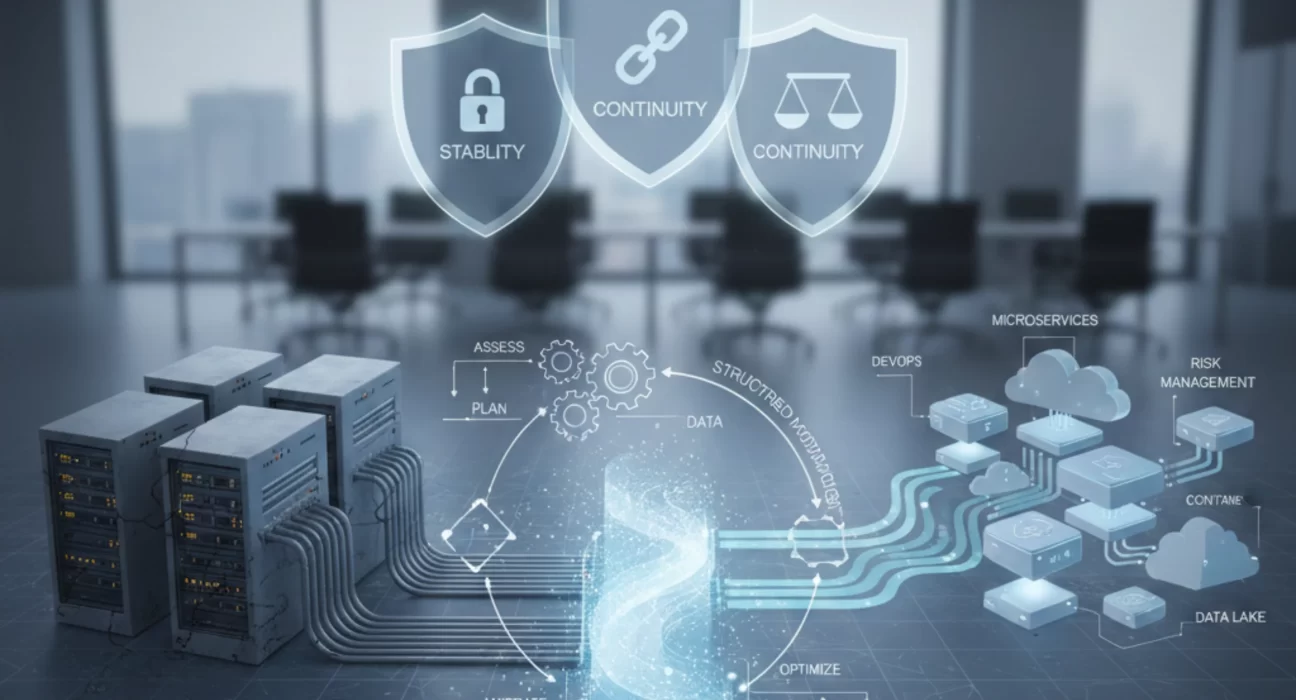
The overriding concern for any executive sponsoring a legacy modernization program should be business continuity. No matter how much better the new system will be, it’s not worth it if the migration process disrupts business operations unacceptably.
This requires several protective measures:
Comprehensive risk assessment that identifies everything that could go wrong and plans for how to prevent or mitigate each risk.
Detailed cutover planning that specifies exactly how you’ll transition from old to new system, including timing, steps, rollback triggers, and responsibilities.
Business process continuity planning that ensures critical business operations can continue even if technical problems occur during transition.
Communication plans that keep all stakeholders informed about what’s happening, what to expect, and what to do if they encounter issues.
Support infrastructure that ensures users have help available when they need it during and after transition.
A financial services firm we worked with demonstrated excellent execution in this area. They were modernizing their loan processing system, which handled thousands of applications daily. Any disruption would mean lost business and regulatory compliance issues.
They spent three months planning the cutover in detail. They ran multiple rehearsals in production-like test environments. They scheduled the cutover during their lowest-volume period. They had the old system fully ready to resume if needed. They had double the normal support staff available. They had executive leadership physically present during the cutover.
The actual cutover went smoothly because of this preparation. There were minor issues, but they were resolved quickly because the team had anticipated them and had solutions ready.
This level of planning and preparation is what separates successful modernization programs from disasters.
Measuring Success Beyond Go-Live
Many modernization programs celebrate when the new system goes live and consider the job done. This is premature. True success is measured by how well the system performs months and years after go-live.
Meaningful success metrics include:
System stability and reliability. Is the new system more reliable than the old one? What’s the frequency and severity of production incidents?
Business process efficiency. Are business processes faster, easier, or more accurate? Can you measure productivity improvements?
User satisfaction. Are users actually happy with the new system? This requires honest feedback, not just survey responses collected under pressure to declare victory.
Total cost of ownership. Is the new system actually cheaper to maintain than the old one? Include all costs: infrastructure, licenses, support staff, and ongoing enhancement.
Business capability delivery. Can you now deliver new business capabilities faster than before? This is often the most important metric but the hardest to measure.
Technical debt management. Is the new codebase maintainable? Are you keeping technical debt under control or already accumulating problems?
Honest assessment of these metrics requires waiting at least 6-12 months after go-live for the system to stabilize and for realistic patterns to emerge.
Organizations that declare success immediately after go-live and move everyone to other projects often find that the new system underperforms expectations. Issues that emerge weeks or months later get less attention because the program team has disbanded and organizational focus has moved elsewhere.
Better practice is to maintain a stabilization period after go-live where the core team remains focused on the new system, monitors it closely, addresses issues promptly, and validates that success metrics are being achieved.
The Hidden People Challenge
Legacy modernization isn’t just a technology challenge. It’s a people challenge that organizations consistently underestimate.
The people who maintain the legacy system often feel threatened by modernization. They’ve built their careers on specialized knowledge of the old system. If that system is replaced, where does that leave them? This anxiety leads to subtle resistance, lack of cooperation, and withholding of knowledge.
The people who will maintain the new system are often different people with different skills. Knowledge transfer from legacy experts to modern engineers is difficult because they speak different technical languages and think about problems differently.
Business users who’ve adapted their processes to work within legacy system constraints need to relearn when the new system works differently. Even if the new system is objectively better, change is difficult and meets resistance.
Managers whose power and influence came from controlling access to the legacy system may resist modernization that threatens their position.
These human dynamics can derail even well-planned technical programs. Managing them requires:
Early and transparent communication about what modernization means for people’s roles and careers.
Clear career paths that show legacy system experts how their skills remain valuable in the new world.
Structured knowledge transfer that captures expertise from legacy system experts before they leave or retire.
Change management programs that help users adapt to new ways of working rather than just training them on new software.
Leadership attention to resistance that identifies and addresses concerns rather than dismissing them as obstruction.
The organizations that handle the people side of modernization well end up with engaged teams who support the change. Organizations that focus only on technology end up with technically successful systems that people resist using or supporting.
Learning from Failure Patterns
Understanding why legacy modernization programs fail helps avoid those failures. Common patterns include:
Scope expansion without timeline or budget adjustment. The program starts as “replace the customer system” and becomes “transform our entire customer experience platform” without adequate replanning.
Loss of key people mid-program. The architect who understood both old and new systems leaves. The business analyst who documented requirements moves to another role. The vendor team gets reshuffled. Knowledge is lost and momentum stalls.
Underestimating transition complexity. The new system works fine. The old system works fine. The integration between them during migration is a disaster nobody planned for adequately.
Technical decisions made without business context. Engineers choose technology they’re excited about without considering supportability, total cost, or alignment with organizational capabilities.
Insufficient executive engagement. The CIO approved the program two years ago but hasn’t been actively involved since. When problems arise requiring executive decisions, there’s no one with authority and context to decide.
Inadequate testing. The team tests that the new system works but not that all business processes work end-to-end with realistic data in realistic scenarios.
Declaring victory prematurely. The system goes live, everyone celebrates, the team disbands, and then the problems start emerging.
Learning from these patterns means building protective measures into your program from the start. Don’t wait until you encounter these problems to address them.
What Actually Works: Proven Principles
Having discussed what goes wrong, let’s be clear about what actually works in legacy modernization programs:
Strong, consistent executive sponsorship. A senior executive who owns the program, removes barriers, makes tough decisions, and keeps organizational focus over multiple years.
Realistic planning and budgeting. Timelines and budgets that reflect actual complexity rather than wishful thinking. Buffer for unexpected issues because they will occur.
Clear accountability and ownership. Someone owns each component, each phase, each decision. When issues arise, it’s always clear who needs to resolve them.
Incremental delivery with validation. Don’t wait years to validate that you’re building the right thing. Deliver and validate continuously.
Disciplined scope management. Clear criteria for what’s in scope and what’s not. Formal processes for scope changes that update plans and budgets accordingly.
Strong program management. Professional program managers who coordinate across teams, manage dependencies, track progress honestly, and escalate issues promptly.
Technical excellence without perfectionism. High quality standards but recognition that good enough today is better than perfect never.
Partnership between business and technology. Joint ownership of decisions and outcomes rather than business making requirements and technology implementing them.
These principles aren’t revolutionary. They’re basic program discipline. But they’re consistently absent in failed modernization efforts and consistently present in successful ones.
Moving Forward with Confidence and Realism
If you’re an executive considering a legacy modernization program, the message of this article might seem discouraging. The challenges are real, the risks are significant, and the timeline is long.
But the alternative continuing to run on aging systems that become progressively more expensive, risky, and limiting is worse. The question isn’t whether to modernize but how to do it successfully.
Success requires several things from leadership:
Commitment to realistic timelines and budgets. Don’t let pressure for quick results push you into unrealistic plans that will fail.
Tolerance for complexity and problems. Modernization is hard. Issues will arise. What matters is having processes to address them, not expecting perfection.
Active engagement throughout. This isn’t something you can approve and forget about. Multi-year programs need consistent executive attention.
Willingness to make hard decisions. Trade-offs between scope, time, cost, and risk are inevitable. Executives need to make these calls, not delegate them indefinitely downward.
Focus on execution and delivery. Technology choices matter, but execution discipline matters more. Focus your attention on program governance, risk management, and accountability.
The organizations that successfully modernize their legacy systems aren’t the ones with the best technology or the biggest budgets. They’re the ones with the best execution discipline and the strongest leadership commitment.
That’s ultimately what determines success or failure in large-scale enterprise transformation programs. The technology is available. The methods are proven. What’s required is the organizational will and discipline to execute well over sustained periods despite complexity and obstacles.
That’s not easy. But it’s absolutely achievable for organizations that approach it seriously and plan accordingly.