

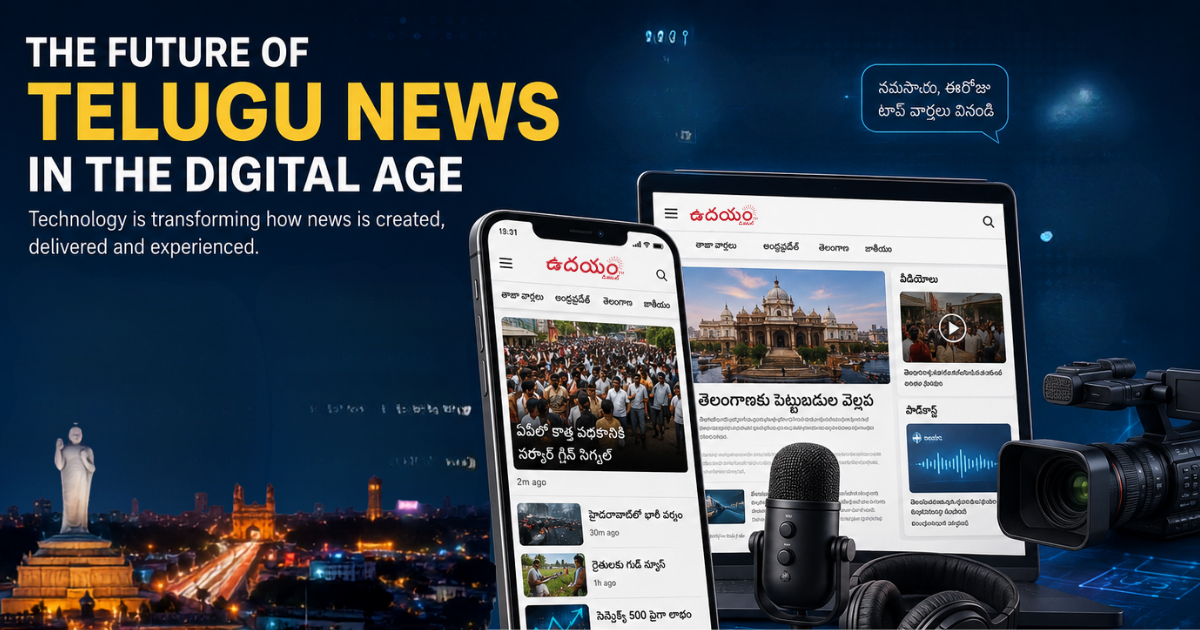
The way Telugu audiences consume news has changed dramatically over the past decade. Smartphones, affordable internet, social media, and digital publishing have transformed how people access information. Instead of waiting for the morning newspaper or scheduled television bulletins, readers now expect breaking news, live updates, videos, and regional stories to be available instantly.
As technology continues to evolve, Telugu journalism is entering a new phase where artificial intelligence, automation, voice technology, and personalized experiences will redefine the news industry. Over the next five to ten years, digital innovation is expected to make Telugu news faster, more accessible, more interactive, and more relevant than ever before.
Artificial Intelligence Will Assist Journalists
Artificial Intelligence (AI) is becoming one of the most influential technologies in modern journalism. Rather than replacing reporters, AI is expected to support newsrooms by handling repetitive tasks that consume valuable time.
AI tools can help journalists summarize lengthy reports, generate headlines, organize information, detect trending topics, and monitor multiple news sources simultaneously. This allows reporters to focus on investigative journalism, interviews, and in-depth storytelling.
For Telugu news organizations, AI can also assist in improving grammar, suggesting better headlines, optimizing articles for search engines, and recommending related stories to readers.
Editorial judgment and human verification will remain essential, but AI will significantly improve newsroom efficiency.
Automated Transcription Will Speed Up Reporting
Journalists spend countless hours converting interviews, speeches, and press conferences into written articles.
Automated transcription tools can now convert spoken Telugu into editable text within minutes.
This technology will help reporters publish stories faster while reducing manual effort. Political speeches, government announcements, public meetings, and interviews can be processed almost instantly, enabling quicker publication of breaking news.
As speech recognition improves, transcription accuracy for Telugu is expected to become increasingly reliable.
Better Telugu Speech-to-Text Technology
Speech recognition for regional languages has improved considerably in recent years.
Future Telugu speech-to-text systems will understand different accents, dialects, pronunciation styles, and conversational speech more accurately.
This advancement will benefit:
- Journalists covering live events
- Students researching current affairs
- Content creators producing regional news
- Users searching news using voice commands
- Accessibility for people who find typing difficult
Voice-driven news discovery will likely become a common habit among Telugu-speaking audiences.
Translation Technology Will Expand Reach
Machine translation is becoming increasingly sophisticated.
Future translation tools will help Telugu news organizations publish stories across multiple Indian languages with greater speed and accuracy.
Likewise, national and international news can be translated into Telugu more naturally, allowing readers to access global developments without language barriers.
This will help regional publishers reach wider audiences while preserving the local context that readers value.
Personalized News Feeds Will Improve User Experience
Modern readers prefer information that matches their interests.
Instead of displaying identical homepages to every visitor, digital platforms are moving toward personalized news feeds.
Artificial intelligence can recommend articles based on reading history, preferred districts, favorite categories, and browsing behavior.
For example, a reader interested in Andhra Pradesh politics may receive political updates first, while another reader interested in cricket may see sports headlines prominently.
Personalization improves engagement while helping readers discover relevant content more efficiently.
Regional Digital Platforms Will Continue to Grow
Digital publishing has lowered many of the barriers that once limited regional journalism. Readers increasingly rely on websites and mobile platforms that deliver fast updates, district-level reporting, and content in natural Telugu.
As this shift continues, publishers are investing in better mobile experiences, multimedia storytelling, and real-time reporting. Platforms such as Udayam Digital illustrate how Telugu news organizations are adapting to changing reader expectations by making news available wherever audiences are—on smartphones, tablets, and other connected devices. This reflects a broader movement toward accessible, digital-first journalism across Telugu-speaking communities.
Short Video News Will Continue Growing
Short-form video has become one of the fastest-growing news formats.
Many readers now prefer watching a one-minute summary instead of reading a lengthy article.
Future Telugu news platforms will increasingly produce the following:
- Breaking news videos
- Election updates
- Business explainers
- Weather reports
- Sports highlights
- Cinema news
- Educational explainers
Videos optimized for smartphones will remain a major source of audience engagement.
Podcasts and Audio News Will Become Mainstream
Audio content is growing rapidly because it allows people to stay informed while commuting, exercising, or working.
Future Telugu news organizations are likely to expand their offerings with the following:
- Daily news briefings
- Political discussions
- Business updates
- Weekly analysis
- Interviews
- Explainer podcasts
Audio journalism will make news more accessible to busy professionals and visually impaired users.
Voice Assistants Will Change News Discovery
Voice-enabled devices are becoming increasingly common.
Instead of typing search queries, users may simply ask:
- “What are today’s Telugu headlines?”
- “Latest Andhra Pradesh news.”
- “Weather in Vijayawada.”
- “Today’s cricket score.”
Voice assistants will deliver personalized news summaries, making information even easier to access.
As Telugu language support improves, voice-based news consumption will continue to expand.
Hyperlocal Journalism Will Become More Important
Readers often care most about what happens in their own town, district, or neighborhood.
Future Telugu journalism will likely place greater emphasis on hyperlocal reporting, covering topics such as the following:
- Local government decisions
- Civic infrastructure
- Education
- Healthcare
- Employment opportunities
- Agriculture
- Community events
- District-level weather
Digital publishing enables news organizations to reach local audiences quickly while maintaining statewide coverage.
Mobile-First Publishing Will Define the Industry
Most Telugu readers now access news through smartphones.
As a result, publishers are increasingly designing content specifically for mobile devices rather than adapting desktop layouts.
Future mobile-first publishing will include:
- Faster-loading pages
- Vertical videos
- Swipe-friendly stories
- Instant notifications
- Cleaner interfaces
- Better accessibility
- Interactive graphics
A seamless mobile experience will remain essential for audience growth.
Fact-Checking and Deepfake Detection Will Become Essential
Artificial intelligence can create realistic fake images, videos, and audio.
This presents significant challenges for journalism.
To maintain public trust, Telugu news organizations will invest more heavily in:
- Fact-checking teams
- AI-powered verification tools
- Reverse image searches
- Metadata analysis
- Deepfake detection systems
- Source verification
Reliable journalism will become even more valuable in an environment where misinformation spreads rapidly online.
Subscription and Advertising Models Will Continue to Evolve
Digital journalism requires sustainable revenue.
Future Telugu publishers are expected to combine multiple income sources, including:
- Digital advertising
- Premium memberships
- Subscription plans
- Sponsored content
- Native advertising
- Video advertising
- Event partnerships
A balanced business model can help news organizations invest in quality reporting while keeping essential news widely accessible.
What the Next Decade Could Look Like
Over the next five to ten years, Telugu journalism will become increasingly intelligent, interactive, and reader-focused. Artificial intelligence, automation, voice technology, personalized experiences, and multimedia storytelling will reshape how news is produced and consumed.
At the same time, the core values of journalism—accuracy, credibility, transparency, and public service—will remain unchanged. Technology will serve as a powerful tool, but trusted reporting will continue to depend on skilled journalists and responsible editorial practices.
For readers, this means faster updates, richer multimedia experiences, easier access to local information, and news delivered in the formats they prefer. As digital adoption continues to rise, platforms like Udayam represent the broader evolution of Telugu journalism toward a future that is mobile-first, technology-driven, and deeply connected to the needs of Telugu-speaking audiences.