
Compliance training is not getting simpler. Regulatory requirements continue to expand across industries, jurisdictions are enforcing penalties more aggressively, and auditors are demanding better documentation of training completion and effectiveness. At the same time, enterprises are managing larger, more distributed workforces that make centralized compliance oversight increasingly difficult.
The challenge is not whether your organization takes compliance seriously. Most large enterprises have robust compliance programs and dedicated teams managing regulatory training. The problem is that many organizations are still managing compliance with systems that were not designed for the complexity and scale they now face. Legacy learning management systems, spreadsheets, and disconnected tools create gaps that auditors find and regulators penalize.
In 2026, the stakes for compliance failures are higher than they have been in years. Regulatory bodies have become more sophisticated in their enforcement, financial penalties have increased, and reputational damage from compliance failures spreads faster through interconnected business networks. This environment requires learning management infrastructure that can demonstrate compliance reliably, not just claim it.
This article explains why modern LMS systems have become essential for enterprise compliance management, what capabilities actually matter, and how organizations can upgrade their compliance infrastructure without creating operational risk.
Why Legacy Systems Create Compliance Risk
Many enterprises are running learning management systems that were implemented ten or fifteen years ago. These systems functioned adequately when they were deployed, but regulatory requirements have evolved significantly since then. What regulators now expect in terms of documentation, tracking, and reporting often exceeds what older systems were designed to provide.
The most common problem is inadequate audit trails. Regulators want to see not just that training was completed, but when it was completed, how long it took, what version of the content was delivered, and whether the learner demonstrated comprehension. Older LMS platforms often lack the granular tracking required to satisfy these requirements. When audit time comes, organizations discover they cannot produce the documentation needed to prove compliance.
Another issue is reporting limitations. Compliance is not just about individual training records. It is about organizational oversight. Regulators want to see that the enterprise has systems in place to identify compliance gaps, escalate risks, and ensure accountability. This requires reporting that can segment data by business unit, location, job role, and regulatory domain. Legacy systems often lack the flexibility to generate these views without manual data manipulation, which introduces errors and delays.
Integration is also a persistent problem. Compliance training requirements are often tied to employee attributes managed in HR systems such as job role, location, or hire date. When your LMS is not integrated with your HR platform, these connections have to be managed manually. People get missed. Changes in role or location do not trigger required training. New hires do not get enrolled in compliance programs on time. These gaps accumulate into audit findings and regulatory exposure.
Finally, there is the problem of user experience. If your compliance training system is difficult to use, employees will avoid it until they are forced to complete requirements. This creates last-minute compliance crunches, increases the workload on your L&D team, and makes it harder to maintain consistent training completion rates. A system that is frustrating to use is a system that creates compliance risk regardless of its technical capabilities.
What Modern LMS Systems Provide for Compliance Management
Modern learning management systems are designed with regulatory compliance as a core use case, not an afterthought. This changes what the technology can do and how reliably it can support enterprise compliance programs.
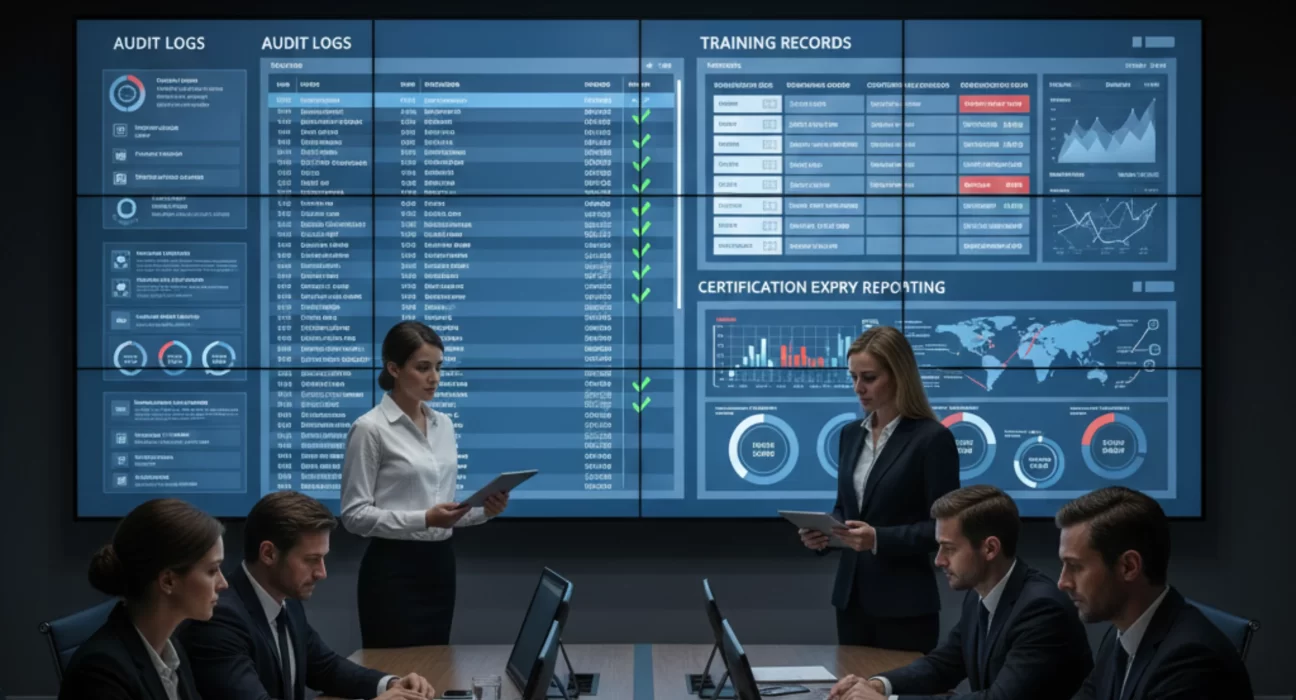
The foundation is comprehensive tracking and documentation. Modern systems capture detailed records of every learning interaction including when training was assigned, when it was accessed, how long was spent on each section, assessment scores, and completion status. This data is stored with timestamps, version control, and audit trails that satisfy regulatory documentation requirements. When an auditor asks for proof of compliance, you can produce complete records without manual reconstruction.
Automated compliance management is another critical capability. Modern LMS platforms can automatically assign training based on employee attributes, trigger recertification when credentials expire, and escalate notifications when deadlines are approaching. This automation reduces the manual overhead of managing compliance programs and ensures that required training is consistently delivered across the organization.
Reporting designed for compliance is also essential. Modern systems provide pre-built compliance dashboards that show completion rates, overdue training, upcoming deadlines, and risk exposure segmented by the dimensions that matter for your organization. These reports are designed for compliance officers and auditors, not just learning administrators. They answer the specific questions that regulators ask without requiring custom development or manual data compilation.
Integration capabilities have also improved significantly. Modern LMS platforms support standard APIs and integration patterns that make it easier to connect with HR systems, identity management platforms, and enterprise data warehouses. This means employee data stays synchronized automatically, training assignments update when roles change, and compliance data can be incorporated into broader risk management reporting.
Mobile accessibility is increasingly important as well. Compliance training needs to reach employees wherever they work, including field personnel, remote workers, and staff in locations without consistent office access. Modern LMS platforms are designed to work reliably on mobile devices with offline capabilities for environments where connectivity is limited. This extends compliance coverage to parts of the workforce that legacy systems often struggle to reach.
Finally, modern systems provide better support for complex compliance scenarios. Multi-language content delivery, region-specific training variants, role-based learning paths, and conditional logic for different compliance requirements are all standard capabilities in current LMS platforms. This flexibility is essential for large enterprises operating across multiple jurisdictions with different regulatory obligations.
The Practical Challenge of Upgrading Compliance Infrastructure
Recognizing that you need a modern LMS for compliance management is one thing. Actually upgrading your compliance infrastructure without disrupting operations is considerably harder. This is not a technology refresh you can execute over a weekend. It is a program that requires planning, stakeholder coordination, and careful execution.
The first challenge is data migration. Your existing compliance training records are evidence of regulatory compliance. You cannot lose this data or compromise its integrity during a system migration. This means you need a structured data migration process that preserves audit trails, maintains data accuracy, and can be validated before you decommission the old system. For organizations with years of compliance history across thousands of employees, this process takes months, not weeks.
The second challenge is maintaining compliance during the transition. You cannot pause regulatory training while you implement a new system. This means you need a transition strategy that allows compliance programs to continue running while the new platform is being configured, tested, and rolled out. Most enterprises handle this through phased deployment where different business units or regulatory domains are migrated at different times to minimize risk.
The third challenge is stakeholder management. Compliance officers, legal teams, HR, IT security, and business unit leaders all have requirements and concerns about how compliance training is managed. These groups need to be consulted, their requirements need to be incorporated into the new system design, and they need to validate that the new platform meets their needs before go-live. This coordination takes time and requires senior-level involvement to resolve conflicts and make decisions.
Integration with existing systems is another significant challenge. Your new LMS needs to connect with your HR platform, identity management system, and potentially other compliance or risk management tools. These integrations need to be designed, built, tested, and validated in your production environment before they can be relied upon for compliance operations. Integration work is often the longest part of enterprise LMS implementations because it involves dependencies on multiple systems and teams.
Finally, there is the challenge of proving to auditors and regulators that your new system is reliable. This requires documentation of system controls, evidence of data integrity, and demonstration that the new platform meets regulatory requirements. Organizations often need to maintain parallel documentation in old and new systems during transition periods until auditors have validated the new infrastructure.
These challenges are manageable with proper planning and experienced implementation partners, but they should not be underestimated. Organizations that rush compliance system upgrades create more risk than they solve.
How Ozrit Delivers Compliance-Focused LMS Implementations
Ozrit is a global technology services company that specializes in enterprise program delivery. We have implemented learning management systems for large organizations in highly regulated industries where compliance is not negotiable. We understand that for these enterprises, system reliability and audit readiness are more important than feature innovation.
Our approach to compliance-focused LMS implementations starts with understanding your regulatory obligations and compliance processes before any technical work begins. We work with your compliance officers, legal teams, and audit functions to map requirements, identify gaps in current systems, and design solutions that will satisfy both operational needs and regulatory expectations. This discovery work is led by senior consultants who have delivered similar programs in regulated environments.
We also build data migration and validation processes that preserve compliance evidence. Your historical training records are not just data. They are legal documentation of regulatory compliance. We treat them accordingly with structured migration processes, comprehensive validation, and audit trails that demonstrate data integrity throughout the transition. This level of rigor is necessary when compliance history is at stake.
Our delivery methodology includes phased rollout that allows compliance programs to continue running without interruption. We do not recommend big-bang deployments for compliance-critical systems. Instead, we structure implementations to migrate business units or regulatory domains incrementally, validating that the new system works correctly before expanding scope. This approach takes longer but dramatically reduces the risk of compliance gaps during transition.
After go-live, we provide 24/7 support to ensure that compliance training operations continue reliably. Our support teams understand your specific regulatory requirements and can respond immediately to issues that could create compliance risk. For regulated enterprises, this level of support is essential infrastructure, not optional service.
We have delivered these implementations for organizations with tens of thousands of employees across multiple countries and regulatory jurisdictions. Our senior team stays involved throughout these programs because they understand that in regulated environments, delivery certainty and audit readiness cannot be delegated to junior resources.
Final Perspective
The regulatory environment in 2026 does not tolerate compliance infrastructure that is outdated, unreliable, or difficult to audit. Organizations that continue operating on legacy systems are accepting compliance risks that their boards and regulators will eventually force them to address. The question is whether that happens proactively through planned upgrade programs, or reactively after audit findings or regulatory enforcement actions.
Modern learning management systems exist specifically to address enterprise compliance requirements at scale. The technology works. The challenge is executing the implementation properly so that compliance operations continue reliably throughout the transition and the new system satisfies both operational and regulatory requirements from day one. Organizations that approach these programs with proper planning, realistic timelines, and experienced implementation partners end up with compliance infrastructure that reduces risk rather than creating it.