
Implementing a new HRIS at enterprise scale is not a technology project. It’s an organizational change program that happens to involve technology. The system touches every employee, affects most HR processes, and contains sensitive data that requires careful governance. Getting it wrong creates operational disruption, compliance risk, and user frustration that persists for years.
Most HRIS implementations fail not because of technical problems, but because organizations underestimate the scope of work required. They focus on software configuration and data migration while neglecting change management, process redesign, and organizational readiness. They set timelines based on vendor estimates rather than a realistic assessment of their internal capacity and complexity.
The result is implementations that run over budget, miss deadlines, and go live with incomplete functionality or poor data quality. Then the organization spends the next two years fixing problems that should have been addressed during implementation.
A successful HRIS implementation requires structured planning, clear ownership, realistic timelines, and sustained executive attention. The work isn’t glamorous, but it’s essential for delivering a system that actually improves HR operations rather than just replacing one set of problems with another.
Understanding What You’re Actually Implementing
An HRIS is not just software. It’s the system of record for your workforce. Employee demographics, compensation, benefits, performance records, career history, and organizational structure. This data drives payroll, supports compliance reporting, informs workforce planning, and underpins dozens of HR processes.
At enterprise scale, this means integrating with multiple systems. Your payroll platform, benefits administration tools, time and attendance systems, recruiting platforms, learning management systems, and identity management infrastructure. The HRIS needs to exchange data with all of these reliably and securely.
It also means supporting complex organizational structures. Multiple business units with different processes, global operations with varying legal requirements, union and non-union populations with different rules, and various employment types with distinct policies. The system needs to handle this complexity without becoming impossible to maintain.
The implementation needs to address all of this. Not just installing software, but designing how data flows between systems, defining governance for data quality, establishing processes for ongoing maintenance, training hundreds or thousands of users, and managing the transition from old systems to new.
Organizations that treat HRIS implementation as primarily a technical project consistently underestimate the scope and struggle during and after go-live. Organizations that recognize it as an organizational change program with significant technical components plan more realistically and deliver better outcomes.
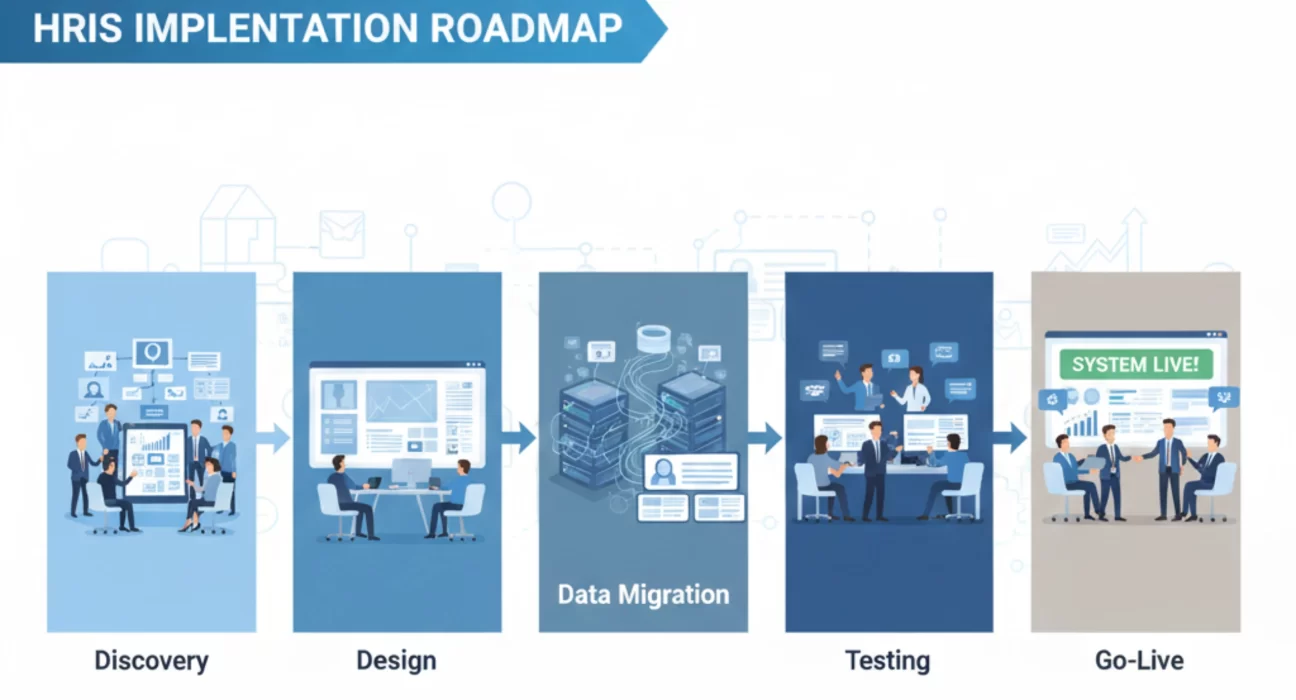
Phase One: Discovery and Planning
The discovery phase determines whether your implementation succeeds or struggles. This is where you document current state processes, identify requirements, assess data quality, evaluate integration needs, and establish the program structure.
Current state documentation reveals how HR processes actually work today, not how they’re supposed to work according to policy documents. How do employees request time off? How do managers initiate compensation changes? How does performance review data flow through various systems? Understanding actual workflows prevents designing new processes that don’t match operational reality.
Requirements definition needs input from multiple stakeholders. HR operations teams who process transactions daily, HR business partners who support managers and employees, compensation and benefits specialists, compliance and legal teams, IT groups responsible for related systems, and finance teams who consume HR data. Each group has legitimate requirements that need to be balanced.
Data assessment identifies what employee data exists, where it lives, what quality issues exist, and how to migrate it cleanly. This work often reveals significant data problems. Inconsistent job codes, incomplete organizational hierarchy data, conflicting information across systems, and missing required fields. These issues need resolution before migration, not discovery after go-live.
Integration requirements mapping documents every system that needs to connect with the new HRIS, what data needs to flow in which direction, how frequently updates should occur, and what happens when integrations fail. This prevents the common problem of discovering critical integration needs late in the implementation, when addressing them requires significant rework.
The program structure established during discovery determines who owns decisions, how issues get escalated, how workstreams coordinate, and what governance processes will manage the implementation. Without a clear structure, implementations bog down in endless meetings where nothing gets decided.
Realistic discovery for an enterprise HRIS implementation takes six to ten weeks. Organizations that try to compress this create problems throughout the rest of the program because fundamental questions remain unanswered.
Phase Two: Design and Configuration
The design phase translates requirements into specific system configuration decisions. How will organizational structure be represented? What approval workflows are needed? Which fields are required versus optional? How will security and access controls work? What reports and analytics are essential?
These decisions require tradeoffs. The system has capabilities, but not infinite flexibility. Some requirements need to be met through configuration, others through workarounds, and some might not be feasible without customization that you want to avoid. Design workshops with stakeholders work through these tradeoffs and reach decisions that balance needs across the organization.
Process redesign happens during the design phase. Implementing new technology while maintaining problematic old processes wastes the opportunity for improvement. If your current performance review process is burdensome and adds little value, implementing it the same way in new software doesn’t help. The design phase should include an honest assessment of which processes should change and how.
Configuration follows design decisions. Building organizational structures, defining workflows, setting up security roles, configuring approval chains, establishing validation rules, and creating required reports. This is detailed technical work that needs to match design specifications exactly while remaining maintainable long-term.
Testing happens throughout configuration, not just at the end. Unit testing, as each configuration element is built, ensures it works as designed. Integration testing validates that different modules work together properly. This progressive testing catches issues early when they’re easier to fix.
Design and configuration for enterprise HRIS typically takes twelve to sixteen weeks, depending on complexity and how many customizations are required. Organizations that try to rush this phase create technical debt that costs more to fix after go-live.
Phase Three: Data Migration and Integration
Data migration is often underestimated in HRIS implementations. It’s not just extracting data from old systems and loading it into new ones. It’s cleaning data, resolving inconsistencies, mapping to new structures, validating accuracy, and establishing cutover procedures.
Data cleansing should happen in source systems before migration when possible. Fixing incomplete records, standardizing formats, resolving duplicates, and correcting errors. Cleaning data in the new system after migration is more difficult and creates ongoing quality problems.
Migration mapping defines how data in old systems translates to the new structure. Job codes might need consolidation, organizational hierarchy might be represented differently, and compensation structures might require transformation. These mappings need documentation and validation by people who understand both the old and new systems.
Multiple migration cycles are essential. The first migration reveals data quality issues and mapping problems. Subsequent migrations validate that corrections work properly. The final migration happens just before go-live when data is as current as possible. Organizations that plan only one migration attempt inevitably discover problems too late to address properly.
Integration development connects the HRIS to other systems that need to exchange data. Payroll, benefits, time tracking, recruiting, learning management, identity systems. Each integration requires development, testing, error handling design, and monitoring setup. Integration failures after go-live create operational disruption, so thorough testing is essential.
Data migration and integration work typically requires eight to twelve weeks, including multiple test cycles and validation. This work often happens in parallel with configuration and testing.
Phase Four: Testing and Training
Comprehensive testing validates that the system works correctly before users depend on it. Unit testing confirms individual functions work. Integration testing validates that modules work together. User acceptance testing ensures the system meets business requirements. Performance testing confirms it handles expected transaction volumes.
Test scenarios should cover normal operations plus edge cases and error conditions. What happens when an employee transfers between business units? How are terminated employees handled? What occurs when approval workflows encounter unusual situations? Testing needs to address these scenarios systematically.
Training preparation develops materials and plans for different user populations. HR administrators who will configure and maintain the system need deep technical training. HR operations staff who process transactions need thorough training on daily workflows. Managers who will use self-service features need focused training on the capabilities they’ll use regularly. Employees who will update their own information need basic orientation.
Training delivery should happen close to go-live so knowledge is fresh when people start using the system. Training delivered months before go-live results in people forgetting what they learned. Staggered training schedules ensure support capacity is available when newly trained users start working in the system.
Documentation serves as an ongoing reference after training. Process guides, quick reference cards, troubleshooting resources, and administrator manuals. This documentation needs to reflect your actual configuration and processes, not generic vendor materials.
Testing and training preparation typically require six to eight weeks, with training delivery happening in the final two to three weeks before go-live.
Phase Five: Go-Live and Stabilization
Go-live transitions users from old systems to the new HRIS. The cutover approach depends on your situation. Some organizations do a complete cutover where everyone switches on the same date. Others phase by location, business unit, or employee population. The right approach balances risk against complexity.
Go-live support requires dedicated resources. A command center staffed with technical experts and process specialists who can address issues quickly. Clear escalation paths when problems exceed the command center’s capabilities. Extended support hours during the initial weeks because issues don’t respect business hours.
Issue triage and resolution processes distinguish between items that need immediate fixes and those that can be addressed later. Critical issues affecting payroll, compliance, or large user populations get priority. Minor issues or enhancement requests get documented for future sprints.
Communication during go-live keeps users informed about status, known issues, and where to get help. Regular updates prevent the help desk from being overwhelmed with the same questions repeatedly. Clear messaging about what’s working, what’s not, and what’s being done builds user confidence.
Stabilization continues for several weeks or months after go-live as the organization adjusts to new processes and resolves issues discovered in production use. This period requires sustained support capacity and patience. Users are learning, processes are being refined, and unexpected issues surface despite thorough testing.
The stabilization period typically runs six to twelve weeks, depending on implementation scope and complexity. Organizations that plan adequate support during this period have smoother transitions than those that assume everything will work perfectly immediately after go-live.
How Ozrit Manages HRIS Implementations
Ozrit’s approach to HRIS implementations emphasizes realistic planning, clear ownership, and sustained execution. The work starts with an honest assessment of your readiness and complexity, not optimistic vendor timelines that ignore organizational realities.
A senior program director owns the entire implementation from discovery through post-go-live stabilization. They manage workstreams, coordinate stakeholders, make decisions when tradeoffs are required, and ensure the program delivers working functionality on schedule. You work with one accountable leader rather than coordinating between multiple vendors or consultants.
The implementation team typically includes ten to fifteen people, depending on the scope. HR process consultants who understand enterprise HR operations, technical specialists who handle configuration and integration, data migration experts who ensure clean data cutover, change management professionals who drive user adoption, and training specialists who prepare the organization.
Realistic timelines for comprehensive enterprise HRIS implementations run nine to twelve months from kickoff to go-live. Organizations with particularly complex requirements, extensive customizations, or challenging data situations may need longer. The timeline reflects actual work required, not aspirational schedules that inevitably slip.
Ozrit maintains 24/7 support during go-live and stabilization because HRIS issues can’t wait until business hours. When payroll processing is affected or critical transactions are blocked, you need immediate access to people who know your configuration and can resolve problems quickly.
The goal is delivering a working HRIS that improves HR operations sustainably, not just completing an implementation project. This requires proper planning, disciplined execution, adequate testing, thorough training, and sufficient support during transition. Organizations that invest appropriately in implementation avoid the painful and expensive remediation work that follows rushed or poorly executed projects.
The Long-Term Perspective
Your HRIS will be in production for many years. The implementation approach determines whether it becomes a trusted system that enables effective HR operations or a source of ongoing frustration that requires constant workarounds.
Implementations done properly cost more upfront but deliver better long-term value. Clean data, well-designed processes, solid integrations, comprehensive training, and adequate stabilization support create a foundation for sustained success. Implementations done quickly and cheaply create technical debt and operational problems that persist for years and cost more to fix than doing it right initially would have cost.
Your HRIS implementation reflects how your organization approaches major technology programs. Disciplined planning, realistic timelines, adequate resources, sustained executive attention, and proper governance produce better outcomes than optimistic schedules, insufficient resources, and hoping for the best. The system your employees and managers will use daily deserves the investment required to implement it properly.