
Every CTO knows the feeling. A new engineer joins your team, full of promise and credentials. You assign them their first task. Three weeks later, they’re still trying to understand where to add a simple validation rule. The code review reveals they’ve accidentally broken two integration points you didn’t know existed.
This isn’t a hiring problem. It’s an onboarding problem. And in enterprise software, it’s costing you more than you think.
The Real Cost of Slow Onboarding
Most enterprises measure onboarding in weeks. They shouldn’t. They should measure it in opportunity cost.
A senior engineer who takes three months to become productive represents roughly ₹15-20 lakhs in delayed value. Multiply that across a team of twelve engineers joining over a year, and you’re looking at meaningful budget impact. Add the downstream effects of delayed releases, frustrated stakeholders, missed market windows, and the numbers become uncomfortable.
But here’s what most executives miss: slow onboarding isn’t just expensive. It’s a symptom of deeper problems in how you’ve built and maintained your systems.
Why Enterprise Codebases Are Different
A startup’s codebase and an enterprise’s codebase aren’t just different in size. They’re different in nature.
Enterprise systems accumulate history. That payment module wasn’t just built it was built in 2015, modified in 2017 to handle GST, patched in 2019 for a regulatory change, and touched by fourteen different developers who’ve since moved to other teams or other companies.
The codebase contains decisions made by people who are no longer around to explain them. It contains compromises made under deadline pressure. It contains clever solutions to problems that no longer exist, and crude workarounds for problems that were never properly fixed.
This isn’t bad engineering. This is reality. Systems evolve under constraints. Business needs change. Teams change. Priorities shift. The codebase reflects all of it.
What Actually Slows New Engineers Down
Documentation isn’t the problem. Most enterprises have documentation. The problem is that documentation describes the system as it was supposed to be built, not the system as it actually exists.
The real barriers are subtler.
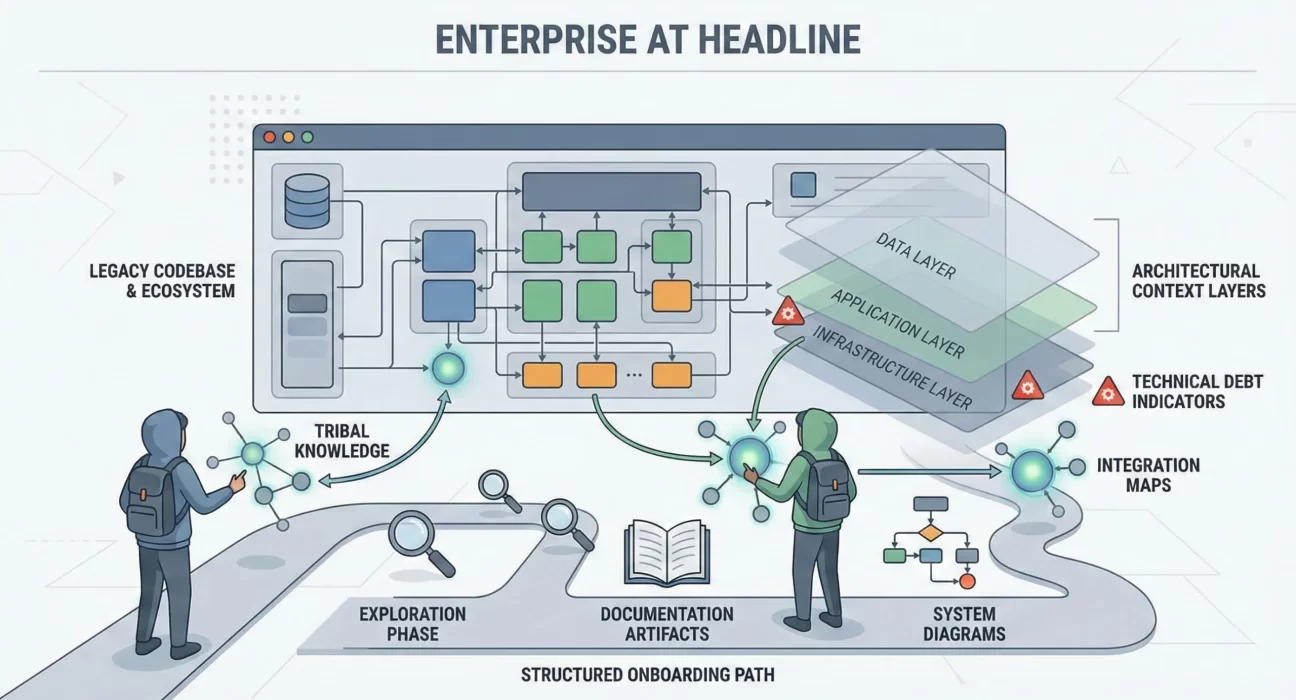
Invisible dependencies. That customer service module talks to seven other services, but only three are documented. The other four were added during an urgent fix two years ago. Nobody updated the architecture diagrams because nobody had time.
Tribal knowledge. The testing environment needs to be restarted in a specific sequence, but that’s not written anywhere. Senior engineers just know. New engineers learn by breaking things.
Inconsistent patterns. The authentication flow works in three different ways across different parts of the system because different teams built different modules at different times using different approaches.
Fear of change. Nobody’s quite sure what depends on this particular service, so everyone’s terrified to modify it. The new engineer inherits that fear without understanding where it comes from.
These aren’t technology problems. They’re organizational memory problems. And you can’t solve them with better documentation alone.
The Onboarding Trap Most CTOs Fall Into
Here’s the standard approach: assign a buddy, share the wiki links, and give them a small task to start with.
It doesn’t work. Not at enterprise scale.
The buddy is usually a senior engineer who’s already overloaded. They’re helpful when asked, but they can’t proactively explain the context that the new engineer doesn’t know they’re missing. The wiki is comprehensive but outdated in critical places. The small task turns out to touch six different systems because nothing in an enterprise is truly isolated.
Meanwhile, the new engineer is trying to prove themselves. They don’t want to ask too many questions. They spend hours trying to figure things out alone. They make incorrect assumptions. They write code that technically works but violates unstated team conventions.
By the time someone reviews their work, they’ve gone down the wrong path for two weeks.
What Works: Structure Without Bureaucracy
Effective enterprise onboarding isn’t about having more processes. It’s about having the right structure.
Clear ownership boundaries. New engineers need to know exactly which parts of the codebase their team owns and which parts they’re merely consumers of. This sounds obvious but is rarely explicit.
Living architecture context. Not documentation that describes the ideal state, but a lightweight context that explains the current state and why it is that way. This includes the compromises, the workarounds, and the planned improvements.
Guided exploration. Instead of reading documentation, new engineers should have a structured path through the codebase, starting with a simple read operation, then a simple write, then understanding one integration point, then another. Each step builds context for the next.
Safe experimentation. This means realistic test environments and clear boundaries about what can be safely changed. Fear of breaking things is the biggest productivity killer for new engineers.
The goal isn’t to make onboarding faster by cutting corners. It’s to make it more effective by reducing wasted effort.
The Governance Problem Nobody Talks About
In most enterprises, onboarding is owned by HR and managed by engineering managers. But the real bottleneck is usually neither.
It’s governance.
New engineers get stuck because they need access to five different systems, each requiring approval from a different team. They need VPN credentials, database read permissions, API keys for the staging environment, and access to the logging dashboard. Each request goes through a separate process. Each process takes three to five days.
This isn’t anyone’s fault. Security matters. Compliance matters. But when governance becomes an obstacle to productivity, you’re paying for both security and inefficiency.
The solution isn’t to relax security. It’s to design security processes that account for the onboarding flow. Pre-approved access patterns for new engineers. Automated provisioning for standard tooling. Clear escalation paths for special cases.
This requires IT, security, and engineering to coordinate. It rarely happens because no single leader owns the end-to-end onboarding experience.
Legacy Systems and the Knowledge Transfer Crisis
Every enterprise has legacy systems. The question is whether you have people who understand them.
The engineers who built your core transaction processing system in 2012 are mostly gone. The engineers who maintain it now inherited it from someone else, who inherited it from someone before that. Each transfer lost some context.
Now you’re onboarding new engineers into a system that nobody fully understands.
This is the knowledge transfer crisis, and it’s getting worse. As experienced engineers retire or move on, enterprises are losing institutional knowledge faster than they can document it.
The traditional response, better documentation, knowledge sharing sessions, and code comments, help but don’t solve the underlying problem. Knowledge isn’t just information. Its context, judgment, and pattern recognition are built over years of working with the system.
You can’t fully transfer that. But you can reduce your dependency on it.
Simplification over documentation. If a module is too complex to explain, consider whether it needs to be that complex. Refactoring isn’t just technical debt management; it’s knowledge preservation.
Redundancy in expertise. No single person should be the only one who understands a critical system. This means intentionally rotating people through different parts of the codebase, even when it’s inefficient in the short term.
External perspective. Sometimes you need someone who can look at your systems with fresh eyes and ask the questions your team has stopped asking. This is where trusted partners like Ozrit can add value not by taking over, but by helping you see what you’ve become blind to.
What Success Actually Looks Like
Successful onboarding in enterprise environments doesn’t mean new engineers are productive in two weeks. That’s a startup metric.
It means they understand enough context to ask the right questions by week three. They can complete a well-scoped task independently by week six. They can propose a design for a new feature by month three. They can navigate the organizational landscape knowing who to talk to, how decisions get made, and where the landmines are by month six.
This timeline isn’t slow. It’s realistic. Enterprises that pretend it should be faster end up with engineers who ship code quickly but create problems that take months to surface.
The Vendor Management Dimension
Many large enterprises don’t just onboard their own engineers. They onboard vendor teams, offshore development centers, and contract developers.
This adds another layer of complexity.
Vendor engineers face all the same challenges as internal engineers, plus additional ones. They have limited access to internal stakeholders. They work in different time zones. They’re managed through contract structures that prioritize delivered features over deep system understanding.
The result is predictable: vendor teams build what’s specified but miss the unwritten context. Integrations work in isolation but fail in production because nobody explained the edge cases. Code is delivered on time but requires extensive rework because it doesn’t align with unstated architectural principles.
This isn’t a vendor capability problem. It’s an onboarding and knowledge transfer problem.
Successful vendor relationships require deliberate onboarding investments. Dedicated architecture sessions. Regular sync-ups that go beyond status updates. Clear escalation paths for ambiguous requirements. And most importantly, treating vendor engineers as part of the extended team rather than external resources.
The CIO’s Dilemma: Speed vs. Safety
Every CIO faces this tension. Business wants faster delivery. IT wants stable systems. New engineers are caught in the middle.
Push them too fast, and they’ll make mistakes that cause production incidents. Slow them down too much, and projects miss deadlines, budgets are overrun, and business stakeholders lose confidence in IT’s ability to execute.
The wrong response is to split the difference, moderate speed, moderate safety. That gives you moderate results.
The right response is to invest in the foundations that enable both speed and safety. Automated testing that catches mistakes before they reach production. Clear architectural boundaries that limit blast radius. Monitoring that surfaces issues quickly. Rollback mechanisms that reduce the cost of failure.
These investments take time and budget. They’re hard to justify in quarterly planning cycles. But they’re what separate enterprises that can move fast from enterprises that can only move carefully.
When to Bring in Outside Help
Most enterprises prefer to handle onboarding internally. It’s sensitive work. It involves proprietary systems. It requires deep context.
But there are situations where an external perspective makes sense.
When you’re scaling rapidly, and your internal team doesn’t have the bandwidth to onboard effectively. When you’re dealing with legacy systems that have become too complex for your current team to fully understand. When you’re integrating acquired companies and need to onboard entire engineering teams into your systems. When you’re modernizing platforms and need to help engineers transition from old patterns to new ones.
In these situations, working with a partner who understands enterprise delivery realities, someone like Ozrit can accelerate the process. Not by replacing your internal onboarding, but by bringing structure, identifying gaps, and transferring proven practices.
The key is choosing partners who understand that onboarding isn’t a training exercise. It’s a business enablement function. Partners who measure success by how quickly new engineers become productive contributors, not by how many training sessions they’ve delivered.
Building for the Long Term
Onboarding isn’t a one-time problem. It’s a continuous challenge.
Your systems will keep evolving. Your team will keep growing. Your business requirements will keep changing. If your onboarding approach doesn’t evolve with them, you’ll find yourself constantly playing catch-up.
This means treating onboarding as a first-class concern in your engineering organization. Not something HR owns with engineering support, but something engineering leadership actively manages.
It means measuring what matters. Not time to first commit, but time to independent productivity. Not completion of training modules, but the ability to navigate complex decisions. Not documentation coverage, but effective knowledge transfer.
It means investing in the unglamorous work. Keeping architecture diagrams current. Maintaining realistic test environments. Simplifying overly complex modules. Building tools that make exploration safer.
None of this is exciting. None of it shows up in quarterly demos to the board. But it’s what determines whether your enterprise can execute at the pace business demands.
The Bottom Line
Onboarding engineers into complex enterprise codebases isn’t a technical problem. It’s an organizational capability.
Enterprises that do it well don’t have better documentation or smarter hiring. They have better systems for transferring knowledge, clearer ownership structures, and stronger alignment between engineering, security, and business.
They recognize that every new engineer represents both an investment and an opportunity. An investment in their growth. An opportunity to question assumptions, challenge legacy patterns, and improve the systems they’re joining.
The enterprises that treat onboarding as a checkbox exercise assign a buddy, share the links, and hope for the best will continue to struggle with long ramp-up times, costly mistakes, and frustrated engineers.
The enterprises that treat it as a strategic capability will build teams that can execute complex programs reliably, scale systems sustainably, and deliver business value consistently.
The choice isn’t between speed and quality. It’s between building the foundations for both or settling for neither.