
The difference between using AI and embedding it into operations is substantial. Using AI means employees have access to tools that help with specific tasks. They might use a language model to draft emails or a prediction tool to inform decisions. The AI sits alongside their work, improving productivity at the margins.
Embedding AI means the technology becomes part of how operations actually function. Orders get routed intelligently without manual triage. Approvals happen automatically based on learned patterns. Exceptions get identified and resolved before they disrupt workflows. The AI is not a tool people use. It is the infrastructure that makes operations faster, more accurate, and more efficient.
Most enterprises are still in the first category. They have AI capabilities available, but those capabilities have not fundamentally changed how core operations work. The business processes look largely the same. The systems function as they always have. People work the same way with slightly better tools.
Moving to the second category requires different thinking about what AI is for and how to implement it. This shift is not about technology sophistication. It is about treating AI as operational infrastructure rather than experimental capability.
Why Embedding AI Is Different From Deploying AI Tools
AI tools can be adopted gradually. Roll them out to teams. Train people to use them. Measure productivity improvements. If a tool does not work well, people stop using it. The risk is limited, and the impact is incremental.
Embedding AI into core operations means the business depends on it functioning correctly. If AI-driven routing fails, orders do not get processed. If intelligent exception handling stops working, operational backlogs develop quickly. If predictive capabilities degrade, resource allocation becomes inefficient, and costs increase. The stakes are higher because the AI is not optional.
This creates requirements that AI tools do not face. Embedded AI must work reliably every day under all conditions. It must handle edge cases gracefully rather than breaking. It must integrate seamlessly with existing systems and processes. It must be monitorable and maintainable by operations teams, not just data scientists. And it must continue working as business conditions change, data patterns shift, and operational requirements evolve.
The implementation challenge is also different. You can deploy AI tools to users and let them figure out how to incorporate them into their work. Embedding AI into operations requires redesigning processes, changing system architectures, establishing new operational procedures, and managing organisational change across teams that may not want their work disrupted.
Where Embedded AI Creates Real Value
The highest-value opportunities for embedded AI are in operations that involve high volumes of routine decisions, where speed and consistency matter, and where patterns in historical data can inform better outcomes.
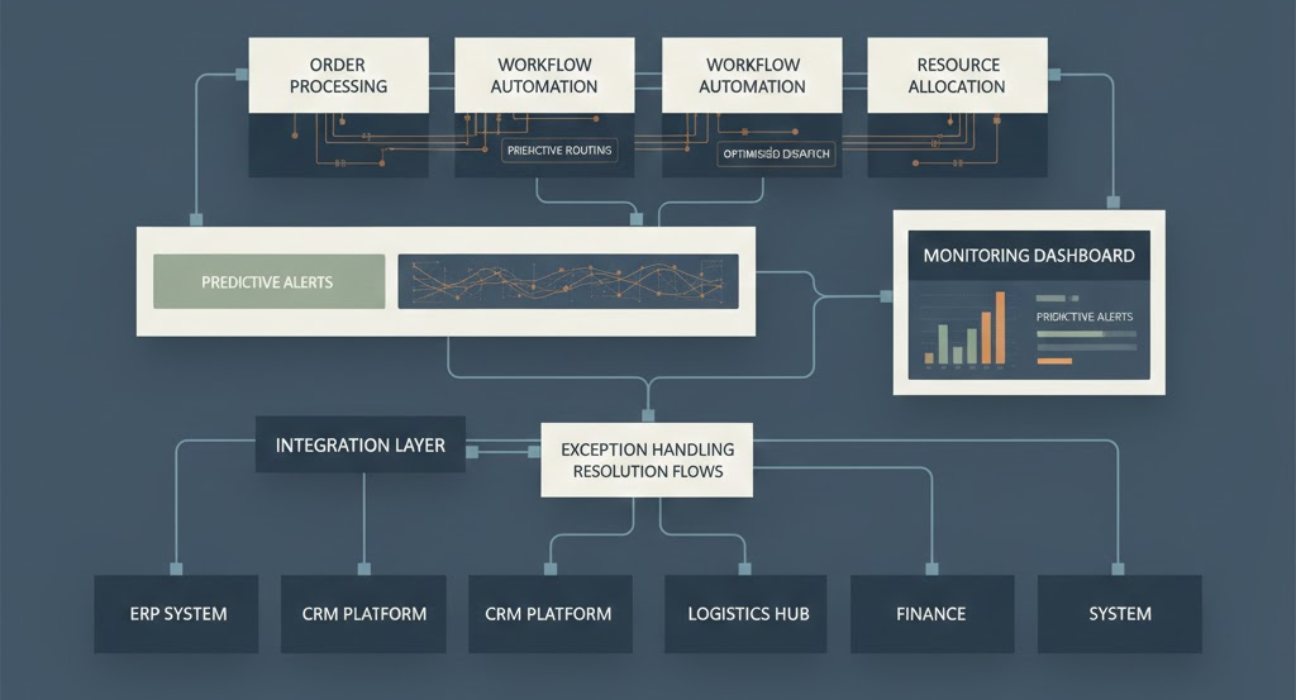
Workflow routing is a natural fit. Large enterprises handle thousands of transactions daily that need to reach the right people at the right time. Manual routing relies on people following rules that never quite cover every situation. AI can analyse transaction characteristics and historical patterns to route work optimally, learning which specialists handle which types of cases most effectively and how to prioritise based on urgency and impact.
Exception handling consumes disproportionate operational resources. Most transactions are straightforward, but the 15 or 20 percent that are exceptions require significant time and expertise. Embedded AI can identify exceptions early, categorise them based on characteristics, and either resolve routine exceptions automatically or route complex ones to appropriate experts with relevant context already gathered. This prevents exceptions from disrupting normal flow and reduces resolution time.
Resource allocation improves when AI can predict demand patterns and optimise how capacity gets deployed. For customer service operations, AI can forecast call volumes by time and topic, allowing better staff scheduling. For logistics operations, it can predict shipping volumes and optimise route planning. For procurement operations, it can identify when inventory should be replenished based on consumption patterns and lead times.
Quality monitoring benefits from AI that can identify anomalies and potential issues faster than human review. Embedded AI can flag transactions that deviate from normal patterns, highlight data that seems inconsistent, and identify process steps where errors occur frequently. This allows proactive intervention before problems become costly.
The common factor is that embedded AI handles routine cognitive work that currently requires human attention. It does not replace judgment on complex decisions. It eliminates the need for judgment on routine decisions and creates capacity for people to focus where their expertise actually matters.
The Technical Foundation That Makes This Work
Embedding AI into operations requires infrastructure that most organisations do not have. The AI needs continuous access to current operational data, not periodic extracts prepared by data teams. It needs low-latency integration with operational systems so decisions can flow immediately into action. It needs monitoring and management capabilities that operations teams can use without specialised data science knowledge.
The data architecture must support AI without creating fragile dependencies. This means clean APIs that provide AI access to relevant data, event streams that allow real-time response to operational activity, and data quality controls that ensure AI receives information it can rely on. Building this infrastructure is substantial engineering work that goes well beyond training models.
The AI itself must be production-grade, not experimental. Models need version control, testing frameworks, deployment pipelines, and rollback capabilities similar to software systems. They need monitoring that detects when performance degrades and diagnostics that help identify why. They need updated procedures that allow improvement without disruption. These capabilities require MLOps expertise that combines data science with software engineering and operations knowledge.
Integration must be seamless rather than bolted on. If AI-driven decisions require manual transfer into operational systems, adoption will be poor, and reliability will suffer. The AI must connect directly into workflow engines, transaction processing systems, and user interfaces so that intelligence flows naturally through operations without creating friction or new manual steps.
How Ozrit Embeds AI Into Operations Platforms
Ozrit builds operations platforms with AI embedded as a core capability rather than added as a separate layer. The company was founded by engineers who understood that AI would become essential to competitive operations and that it needed to be architected in from the beginning, not retrofitted later.
The platform architecture treats AI as infrastructure. Intelligent routing, exception handling, predictive capabilities, and anomaly detection are built-in services that operational processes can use naturally. Configuration determines how and where AI applies, but the underlying capability is always available and maintained as part of the platform.
For workflow automation, the AI learns from operational history to understand which cases need what kind of attention. It routes work based on complexity, urgency, specialist availability, and past performance patterns. As new cases are resolved, the system continuously refines its understanding. This happens automatically without requiring data scientists to periodically retrain models.
Exception handling uses pattern recognition to identify when transactions deviate from normal parameters. The system can automatically resolve exceptions it has seen before based on established resolution patterns. For novel exceptions, it escalates to humans with relevant context and suggests potential approaches based on similar historical situations.
Predictive capabilities help operations stay ahead of problems. The platform identifies bottlenecks forming before they impact delivery, predicts resource needs before capacity becomes constrained, and flags quality issues before they affect customers. These predictions integrate directly into operational dashboards and alert systems that operations teams already use.
The AI degrades gracefully when it encounters situations outside its experience. Rather than making poor decisions or failing, it routes these cases to human judgment and flags them for review. This ensures reliability even as business conditions change in ways the AI has not encountered before.
Implementation Approach That Reduces Risk
Ozrit structures AI embedding programs to manage the complexity and risk that make these initiatives difficult. The approach begins with an operational assessment, typically four to six weeks, that identifies where AI can create a measurable impact in current operations. This assessment examines process characteristics, data availability, integration requirements, and organisational readiness.
The implementation happens in phases that each deliver working AI capability for specific operational areas. The first phase typically focuses on one high-value process like order routing or exception handling, where success can be validated clearly. This proves the approach works in production conditions before expanding to additional areas.
Each phase includes extensive validation that goes beyond model accuracy. Testing covers reliability under load, behavior with poor quality data, integration stability, and operational impact. The AI must demonstrate that it improves operations measurably before deployment expands.
Deployment follows a controlled approach where AI capability is introduced gradually with human oversight. For routing decisions, AI might initially suggest routes while humans make final decisions. As confidence builds through demonstrated accuracy, the AI takes over routine decisions while humans handle complex cases. This transition happens at a pace the organisation can absorb.
A realistic timeline for embedded AI capability is 6 to 12 months for focused implementations in specific operational areas, or 12 to 18 months for comprehensive AI across major operations. These timelines assume reasonable data infrastructure and organisational readiness. Delays typically come from data quality issues, integration complexity, or change management requirements rather than AI technology itself.
Ozrit assigns senior AI architects to embed programs because the decisions about where AI applies, how it integrates, and how it operates have long-term implications. These are engineers who have built production AI systems before and understand what actually works at enterprise scale. They remain involved through deployment and initial operations, not just during planning.
Managing the Organisational Transition
Embedding AI changes how people work, which creates resistance if not managed carefully. Roles shift as AI handles tasks people currently do. Some jobs change significantly. People worry about their value when technology does work they previously owned.
Addressing this requires honesty about what is changing and clarity about what new work looks like. When AI handles routine routing decisions, the people who previously did that work shift to handling complex cases that AI cannot resolve. This is often more interesting work requiring more expertise, but the transition requires training and time to build confidence.
Communication must start early and continue throughout implementation. Teams need to understand why AI is being embedded, what specific changes will occur, when those changes will happen, and how they will be supported through the transition. Surprises create resistance. Clear expectations create the foundation for successful change.
Training happens before go-live, not after. People need time to learn new ways of working before they are responsible for using them in production. Training includes both technical skills for working with AI-enhanced systems and conceptual understanding of what the AI does and does not do. This builds appropriate trust rather than blind acceptance or blanket skepticism.
Support during transition is critical. Early weeks after AI deployment will surface questions, confusion, and situations no one anticipated. Having knowledgeable people available to help, clarify, and adjust as needed prevents small issues from becoming major problems. This support gradually decreases as teams become comfortable with new operations.
Operating Embedded AI Continuously
The operational work begins after deployment. Embedded AI requires continuous monitoring and maintenance to ensure it keeps performing as operations evolve. Data patterns shift. Business conditions change. New edge cases appear. Without active management, AI systems degrade until they create problems rather than solving them.
Ozrit platforms include monitoring that tracks both technical AI performance and business outcomes. Technical metrics show model accuracy, prediction confidence, data quality, and processing latency. Business metrics show whether AI is actually improving operational results like cycle time, throughput, accuracy, and cost. Both levels of monitoring are necessary to understand whether embedded AI is working correctly.
When performance issues appear, diagnostic capabilities help identify root causes. Is the model degrading because data distributions shifted? Has data quality decreased? Are edge cases appearing that the training data never included? Clear diagnosis allows targeted remediation rather than trial-and-error troubleshooting that disrupts operations.
Model updates follow structured processes that prevent disruption. Changes are tested thoroughly in environments that mirror production before deployment. Rollback capabilities ensure that if an update causes problems, the system can quickly revert to the previous stable state. This discipline is essential when AI is embedded in operations that cannot tolerate extended disruption.
The 24/7 support includes AI engineers who understand the operational context and can respond effectively when issues occur. When embedded AI malfunctions, it affects business operations immediately. Response must be fast and competent, not routed through multiple support tiers before reaching someone who can actually help. Ozrit support provides direct access to engineers who built and maintain the systems.
Governance That Scales With Adoption
As AI embeds deeper into operations, governance becomes increasingly important. Clear ownership and accountability must exist for AI-driven decisions. Policies must define acceptable AI applications and prohibited ones. Oversight must catch issues before they become serious.
Ozrit helps establish governance frameworks appropriate for the organisation’s industry, risk tolerance, and regulatory environment. This includes decision rights for approving new AI applications, standards for data usage and model development, processes for testing and deployment, and mechanisms for ongoing oversight.
Compliance receives explicit attention. Different industries face different requirements around automated decision-making and algorithm transparency. Financial services have strict regulations. Healthcare has patient privacy and treatment standards. Government contracting has fairness and auditing requirements. The AI implementation must satisfy these requirements while delivering operational value.
Explainability gets built in where required. Some decisions must be explainable to customers, regulators, or auditors. The platform maintains audit trails showing why AI made specific decisions, what data informed those decisions, and what alternatives were considered. This satisfies compliance requirements and builds trust in AI-driven outcomes.
Human accountability remains clear. When AI makes a decision that causes problems, someone must be accountable for fixing it and preventing recurrence. The governance framework establishes this accountability explicitly rather than assuming it will emerge naturally.
The Strategic Value of Embedded AI
Embedded AI creates a competitive advantage that accumulates over time. Operations become faster, more efficient, and more reliable. Customer experience improves. Costs decrease. The organisation can handle higher volumes without proportional increases in operational resources.
These advantages compound as AI embeds more deeply and learns from more operational data. The organisation that embeds AI effectively today will operate more efficiently next year and even more efficiently the year after. Competitors who delay will find themselves at increasing disadvantage as the gap widens.
The investment required is substantial. Platform development, implementation, data infrastructure, and organisational change all consume resources. For meaningful embedded AI across core operations, total investment will reach millions over the program lifecycle.
The return comes from sustained operational improvement that translates to financial performance. Faster operations increase throughput. Better accuracy reduces errors and rework. Improved resource allocation reduces waste. These benefits continue year after year as long as the AI remains well-maintained and aligned with business needs.
What Makes the Difference
Embedding AI into core operations succeeds when organisations treat it as an infrastructure investment requiring proper engineering, not as innovation projects requiring only data science. The technical foundation must be solid. The operational integration must be seamless. The governance must be clear. And the organisational change must be managed deliberately.
Organisations that approach embedded AI this way build operational capabilities that competitors struggle to match. Operations become genuinely intelligent, adapting and improving continuously. This is not about having impressive technology. It is about making operations work better in ways that create material business advantage.