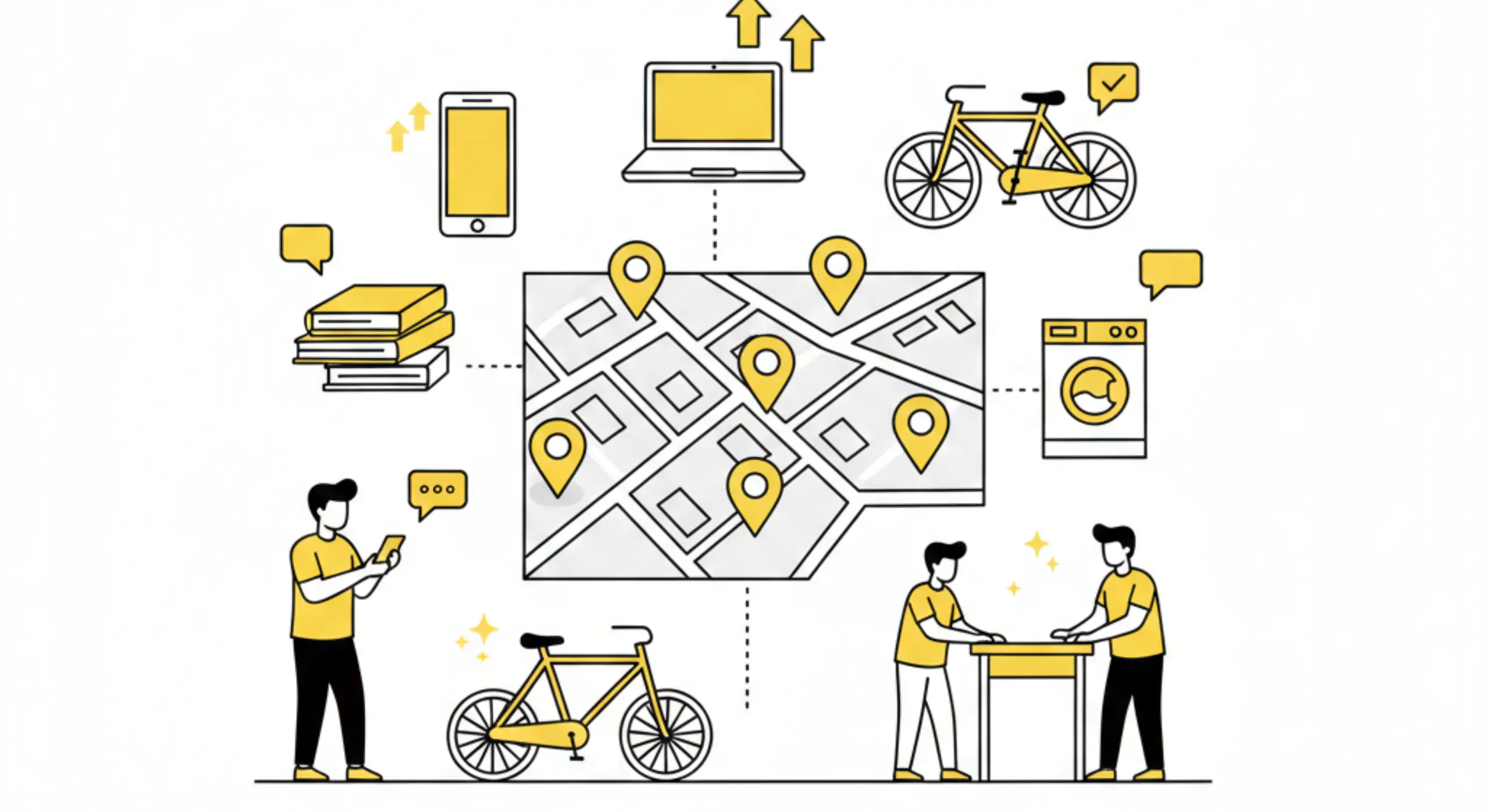


There’s a camera in your closet you haven’t used in a year. A treadmill folded up in the corner that became a clothes hanger. Textbooks from last semester stacked on a shelf. A gaming console you replaced six months ago.
All of it is worth money. All of it taking up space. All of it sitting there because you can’t bring yourself to deal with selling it.
Not because you don’t want the cash. Not because you enjoy the clutter. But because every time you think about listing something online, you remember what it’s actually like.
The endless form fields. The category maze. The verification emails. The messages from people who’ll never actually buy. The coordination attempts with buyers three cities away who ghost you after two days.
So you don’t list it. You tell yourself you will eventually. Eventually becomes never. And your stuff continues occupying expensive real estate in your home while depreciating in value.
This isn’t a personal problem. It’s a platform design problem. And Sympl fixes it.
The Lie Platforms Tell You About Convenience
Most marketplaces claim they make selling easy. Their landing pages promise “List in minutes!” and “Reach millions of buyers!” and “Sell anything, anywhere!”
Then you actually try to use them.
You create an account. Verify your email. Verify your phone. Set up a profile. Add a profile picture they “recommend” for building trust. Answer questions about your seller preferences.
You haven’t even started listing your item yet.
Now comes the actual listing. Choose a category. Is your phone under Electronics > Mobile Phones > Smartphones? Or Electronics > Used Mobiles > Brand Name? Pick wrong and fewer people see it.
Upload photos. But they need to be a certain format, under a certain file size, minimum resolution, showing the item from specific angles. Three photos minimum. Eight maximum. Make sure the lighting is good or buyers won’t trust you.
Write a description. How detailed should it be? Should you include specifications? What about that tiny scratch on the back that mentions it now or during negotiation? Use the right keywords or the algorithm won’t surface your listing.
Set your price. Check what similar items are sold for. Not listed for sale. That’s different data and harder to find. Factor in the platform’s commission if applicable. Leave room for negotiation because everyone expects that.
Choose if you want to promote your listing. “Get 3x more views!” Costs extra. Worth it? Maybe? You don’t know.
Finally, you publish. Except now you’re supposed to “optimize” your listing by sharing it on social media, responding to questions within one hour, adjusting your price based on view counts, and checking analytics about who’s engaging with your post.
This is the “easy” process. And we wonder why people give up.
What Actually Happens After You List
Let’s say you push through all that and your listing goes live. Here’s what the next week looks like.
Day one: Nothing. Your listing is buried under hundreds of others posted today. The platform’s algorithm hasn’t decided if it’s worth showing yet.
Day two: Your first message! Someone asks if the item is still available. You say yes. They never reply again. You’ve just experienced your first time-waster.
Day three: Two messages. One person offers 40% of your asking price, no negotiation, no explanation. Another asks if you’ll deliver the item to their city, which is 200 kilometers away. You decline both.
Day four: Someone seems serious. They ask good questions. You answer thoroughly. They say they’re interested and will “get back to you soon.” They don’t.
Day five: A message asking if you’ll accept payment after delivery. Another asking if you can hold the item for two weeks. Another lowball offer.
Day six: You’re wondering if your price is too high, your photos are bad, or if there’s something wrong with your listing. There isn’t. This is just how it goes.
Day seven: You’re debating whether to relist, drop the price significantly, or give up entirely.
Meanwhile, that camera is still in your closet. The treadmill is still in the corner. The textbooks are still on the shelf. Nothing has changed except you’ve wasted a week.
The platform didn’t make selling easy. It made you work for free while pretending to help.
Why Distance Ruins Everything
Most platforms proudly advertise their reach. “Millions of users across India!” “Sell to anyone, anywhere!”
Sounds great. Completely impractical for regular people selling used items.
Your listing for a study table shows up in search results for someone in Delhi. You’re in Pune. They message you. “Can you ship it?”
Shipping a table costs nearly as much as the table itself. Plus packaging, plus the risk of damage in transit, plus the hassle of actually getting it to a courier service. You’re not equipped for this. You’re not a business. You’re just someone selling a table.
You explain you’re only selling locally. They lose interest. You’ve both wasted time.
Or worse: they keep pushing. “Can’t you just try to ship it?” “What if I pay extra?” “My cousin might be in Pune next month, can you hold it?”
None of these conversations lead anywhere because the fundamental problem is distance. They’re not nearby. They can’t come see it. The logistics don’t work for either of you.
But the platform connected you anyway because it prioritizes scale over usefulness. More connections mean more engagement metrics, even if those connections are useless.
Local-only listings solve this instantly. If someone messages you, they can actually come see the item. If they’re interested, the deal can close today. If they’re not serious, you find out immediately and move on.
Distance creates friction. Proximity removes it.
The Psychology of Never Selling
Let’s talk about why that camera is still in your closet months after you decided to sell it.
It’s not about the difficulty of selling. It’s about the anticipated difficulty versus the perceived reward.
You mentally calculate what it’ll take to sell that camera worth twelve thousand rupees. Upload photos, write descriptions, answer messages, coordinate meetups, maybe deal with no-shows. That feels like three to four hours of work minimum.
Twelve thousand rupees divided by four hours is three thousand per hour. That’s decent. But it’s not guaranteed. You might spend those four hours and not sell it. You might sell it for less after negotiating. You might waste a weekend on attempted meetups that fall through.
Suddenly the math doesn’t work anymore. The guaranteed effort for uncertain return makes you procrastinate.
This is where platform design becomes critical. If listing something takes twenty minutes instead of two hours, the calculation changes. If buyers are local and serious instead of distant and flaky, the success probability changes. If the platform isn’t fighting you with unnecessary complexity, the emotional burden changes.
Sympl understands this psychology. Every feature that doesn’t directly reduce your effort gets cut. Every step that doesn’t directly increase your success rate gets eliminated. What remains is a platform designed around completing transactions, not extracting engagement.
What Sympl Actually Removes
Let’s be specific about what you don’t do on Sympl.
No lengthy profiles. You’re not building a seller identity. You’re selling a camera. That doesn’t require a biography, profile picture, location verification, and trust score.
No category complexity. Straightforward options. Electronics, vehicles, furniture, books, sports equipment. Pick the obvious one and move on.
No algorithm gaming. Your listing shows up based on recency and relevance to local buyers. Not based on how many keywords you used, how perfectly you filled out optional fields, or whether you paid for promotion.
No shipping coordination. Everything is local pickup. You meet, they inspect, you exchange items for money. No packaging, no courier services, no tracking numbers, no delivery confirmation.
No platform-mediated payments. You and the buyer handle payment directly. Cash, UPI, bank transfer whatever you both agree on. Sympl doesn’t take a cut and doesn’t need to be involved.
No performance analytics. You don’t need to know how many people viewed your listing, what percentage clicked through, or how you compare to similar sellers. You just need to know if someone wants to buy it.
No mandatory response times. You’re not running a customer service operation. You reply when you can. Buyers who are serious will wait a few hours. Buyers who aren’t serious weren’t going to buy anyway.
Each of these removals makes the process lighter. Easier. Less like work. More like what it should be: a simple transaction between two people in the same city.
Who Benefits Most (It’s Probably You)
Sympl is built for normal people in normal situations.
Students are constantly transitioning. New semester, new city, new room, new needs. You’re buying cheap and selling fast. You don’t have time for complicated platforms or distant buyers. You need to list your old desk and buy a new one before classes start Monday.
Professionals who upgrade devices. Every two years, a new phone, new laptop, new tablet. Trading in gets you insulting offers. Selling privately gets you actual value—if the platform doesn’t waste your time. Sympl makes it worth the effort.
Families managing households. Kids outgrow everything. Furniture gets replaced. Appliances break or get upgraded. You’re constantly cycling through items. A platform that makes each transaction quickly compounds into massive time savings.
First-time sellers are intimidated by complexity. You’ve never sold anything online. Most platforms make you feel like you need a tutorial. Sympl is intuitive enough that you don’t second-guess yourself.
Anyone who’s tried other platforms and quit. You listed something once. It sat for weeks. You got frustrated messages. Nobody seriously contacted you. You gave up. Sympl is designed specifically for people burned by that experience.
If you own things you don’t use and live in a city with other humans, Sympl makes sense for you.
The Local Marketplace That Should Have Always Existed
Here’s what’s strange: local classifieds used to be simple.
Newspaper ads. Community bulletin boards. Word of mouth. Someone needs a bike, someone’s selling a bike, they connect, they meet, deal done.
Then the internet arrived and should have made this easier. Instead, platforms made it complicated because complexity justified their existence. Features became selling points even when those features created friction.
Sympl goes backward to go forward. It asks: what if we built online classifieds that worked like the old simple model, just faster and more convenient?
Post what you’re selling. People nearby see it. Someone contacts you. You meet. Transaction complete.
No unnecessary layers. No artificial complexity. Just the essential function: connecting local buyers with local sellers.
This isn’t revolutionary. It’s restorative. It’s bringing back what worked and removing what doesn’t.
What Happens When Sympl Launches
Sympl is launching soon. When it does, here’s what becomes possible.
That camera in your closet? Listed in three minutes. Sold within a week to someone who lives twenty minutes away. Money in your account, space in your closet, one less item occupying mental bandwidth.
That bike gathering dust? Posted with two photos and three sentences. The buyer comes to test-ride it, hands you cash, and rides away happily. Total time investment: maybe an hour including the meetup.
Those textbooks you’re done with? Listed while you’re waiting for the bus. The student messages you that evening, meets you at a coffee shop the next day, buys the whole stack. You just funded part of next semester.
Multiply this across everything you’ve been meaning to sell but haven’t because platforms made it too hard. That’s hundreds or thousands of rupees you’re leaving on the table right now. Sympl unlocks it.
And if you’re buying, you gain access to a marketplace of local sellers who aren’t running businesses or playing games. Just people selling things they don’t need to people who do. Fair prices, fast transactions, inspection before purchase.
Conclusion
Selling your stuff shouldn’t require motivation. It shouldn’t require weekend projects. It shouldn’t require learning a platform.
It should be boring and quick. List, connect, sell, done. Move on with your life.
Most platforms can’t deliver that because they’re solving different problems: How do we maximize engagement? How do we extract more revenue? How do we grow user numbers?
Sympl solves your problem: How do I turn this thing I don’t use into money with minimum effort?
That difference matters. It’s the difference between platforms built for investors and platforms built for users.
Your camera is still in the closet. The treadmill is still folded up. The textbooks are still stacked.
When Sympl launches, that changes. Not because you’ll suddenly become more motivated. But because the platform will stop working against you.
Simple as it should be.