

Every few years, a new wave of technology promises to transform how enterprises operate. Right now, that technology is AI. And like every wave before it, the real challenge is not whether the technology works. It’s whether your organisation can actually deliver it at scale.
Most C-level executives have already seen a handful of AI pilots. Some worked beautifully in controlled environments. A few even made it to production in one department. But when you try to scale that success across business units, geographies, and legacy systems, things fall apart. Fast.
This is not a technology problem. It’s an execution problem.
The gap between a working prototype and an enterprise-grade AI system is where most programs fail. Not because the AI wasn’t smart enough, but because the organisation wasn’t ready. The governance wasn’t clear. The data wasn’t clean. The stakeholders weren’t aligned. And the team running the program didn’t have the maturity to navigate the mess that comes with large-scale enterprise delivery.
If you’re leading or sponsoring an AI initiative that needs to work across multiple business units, you already know this. The question is: what does it actually take to get it right?
Why Enterprise AI Programs Fail at Scale
Let’s start with what usually goes wrong.
You launch an AI initiative with a clear business case. Marketing wants better customer segmentation. Operations wants predictive maintenance. Finance wants fraud detection. IT wants to modernise the stack. Everyone agrees AI is the answer.
Six months in, you have three separate vendors working on three separate platforms. Each business unit has different data standards. Nobody can agree on who owns the models. Compliance is asking questions you can’t answer. And the CFO is asking why the budget has doubled.
This is not an exaggeration. This is Tuesday in most large enterprises.
The problem is not the AI. The problem is that AI systems touch everything. Data pipelines. Security policies. User workflows. Compliance frameworks. Legacy integrations. Vendor contracts. Change management. And unless you design for that reality from day one, you end up with fragmented systems that can’t scale, can’t talk to each other, and can’t be governed.
Here’s what separates programs that scale from programs that stall:
Unified governance from the start. You need one clear owner, one decision-making framework, and one set of standards that applies across all business units. Not eventually. From day one. If every department is building their own AI strategy in isolation, you don’t have an enterprise program. You have a collection of side projects.
Data strategy before model strategy. Most AI programs start with models and then scramble to find clean data. It should be the other way around. If your data is siloed, inconsistent, or buried in legacy systems, no amount of clever algorithms will fix that. You need a plan to centralise, standardise, and govern data across the organisation before you build anything on top of it.
Realistic timelines and budgets. Enterprise AI is not a six-month project. It’s a multi-year transformation. If your timeline assumes everything will go smoothly, you’re setting yourself up for failure. Build in time for integration challenges, vendor delays, compliance reviews, and the inevitable discovery that half your master data is wrong.
The right kind of partner. Most vendors will sell you their platform and walk away. What you actually need is a partner who understands enterprise delivery. Someone who has managed large-scale programs, navigated governance issues, handled legacy integrations, and delivered systems that actually work in production across multiple business units.
This is where companies like Ozrit come in. Not as a technology vendor, but as a program execution partner who understands what it takes to deliver at enterprise scale.
What It Really Takes to Scale AI Across Business Units
Scaling AI is not just a technical challenge. It’s an organisational one. And the organisations that succeed are the ones that treat it as a program, not a project.
Here’s what that means in practice.
Executive ownership that goes beyond sponsorship. You need a senior leader who owns the outcome, not just approves the budget. Someone who can resolve conflicts between business units, make tough calls on prioritisation, and hold the delivery team accountable. If the CEO or COO isn’t actively involved, the program will drift.
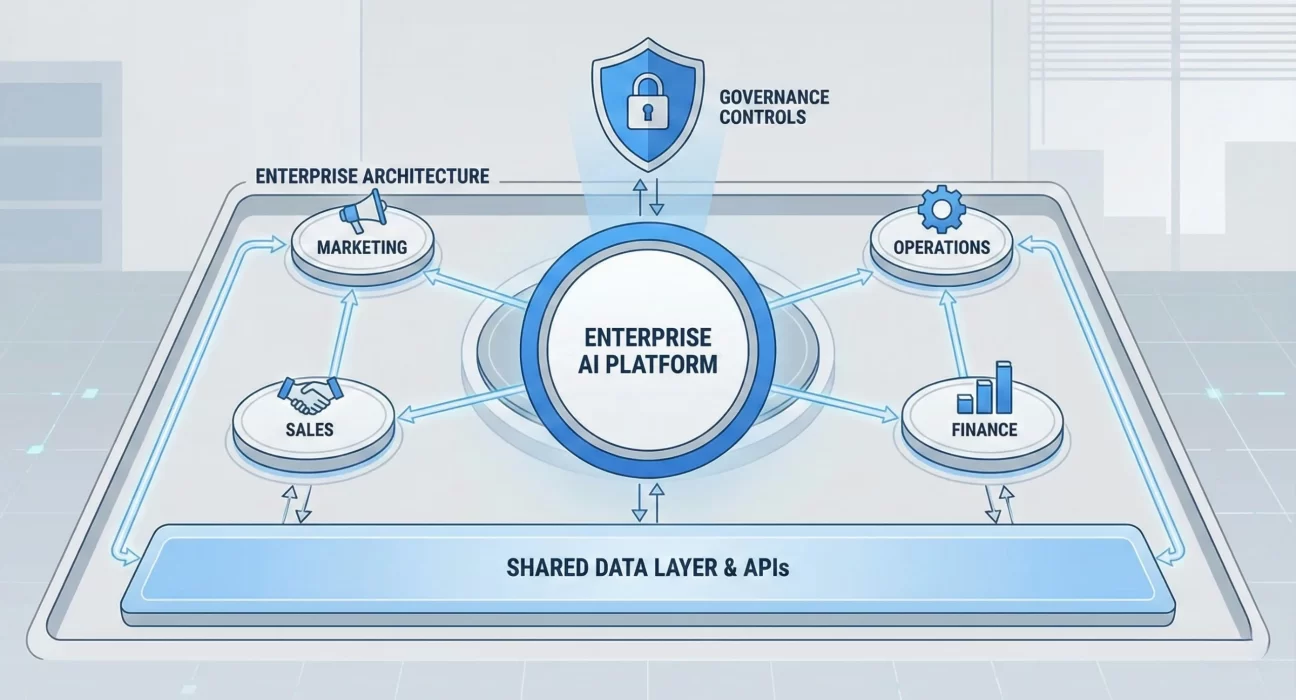
A single platform strategy, not a patchwork of tools. Every business unit will want their own tools, their own vendors, their own approach. You cannot let that happen. You need one platform, one data layer, one set of APIs, and one governance model. Otherwise, you end up with systems that can’t integrate, models that can’t be reused, and a total cost of ownership that spirals out of control.
Delivery maturity that matches the complexity. Enterprise AI programs fail when you treat them like simple software projects. You need program managers who understand stakeholder alignment, risk management, compliance, vendor coordination, and long-term sustainability. You need architects who have dealt with legacy systems, data migration, and security at scale. You need delivery teams who know the difference between a demo and a production-ready system.
Incremental rollout with clear success metrics. You cannot scale AI across the entire organisation on day one. Start with one business unit. Prove the value. Build the governance model. Then expand systematically. Each rollout should have clear metrics, clear timelines, and clear ownership. And if something isn’t working, you stop, fix it, and move forward. You don’t push broken systems into production because you’re behind schedule.
Ongoing governance and evolution. AI systems are not static. Models drift. Data changes. Regulations evolve. You need a governance framework that includes model monitoring, performance reviews, compliance audits, and continuous improvement. If you think the work is done once the system goes live, you’re not ready for enterprise AI.
The Role of Leadership in Enterprise AI Delivery
The biggest factor in whether an enterprise AI program succeeds or fails is leadership. Not the quality of the algorithms. Not the choice of platform. Leadership.
Because at scale, the challenges are always organisational. Who owns the data? Who approves the models? Who decides which business unit gets prioritised? Who resolves conflicts between IT and operations? Who ensures compliance with Indian data protection laws and global regulations?
These are not technical questions. They are leadership questions. And if they don’t get answered clearly and early, the program will stall.
Here’s what good leadership looks like in practice:
Clear accountability. One person owns the program. One person is responsible for delivery. One person answers to the board when things go wrong. If accountability is diffused across a steering committee, nothing gets done.
Disciplined prioritisation. Every business unit will want AI for their use case. You cannot do everything at once. Leadership needs to pick the highest-impact use cases, sequence them properly, and say no to the rest. This is hard. But it’s necessary.
Active risk management. Enterprise AI comes with risks. Data privacy risks. Model bias risks. Compliance risks. Vendor lock-in risks. Leadership needs to identify these risks early, put mitigation plans in place, and review them regularly. Ignoring risks doesn’t make them go away. It just makes them worse.
Long-term thinking. AI is not a one-time project. It’s a capability you’re building for the next decade. That means investing in the right architecture, the right governance, and the right people. It means choosing partners who will be around for the long haul, not vendors chasing the next deal.
Choosing the Right Partner for Enterprise AI Delivery
Most enterprises don’t have the internal capability to deliver AI at scale. That’s fine. But choosing the wrong partner can be worse than doing nothing.
The technology vendors will tell you their platform solves everything. It doesn’t. Platforms are important, but they’re just one piece of the puzzle. What you actually need is a partner who understands enterprise program delivery.
Look for these things:
Experience with large-scale enterprise programs. Have they delivered multi-year, multi-business-unit programs before? Do they understand governance, stakeholder management, risk mitigation, and long-term sustainability? Or are they just developers who build features?
Delivery maturity, not just technical skills. Can they manage timelines, budgets, and scope? Can they navigate vendor relationships, compliance requirements, and legacy integrations? Can they handle the organisational complexity that comes with enterprise delivery?
A focus on execution, not just consulting. You don’t need another deck of recommendations. You need a team that will own the delivery, manage the risks, and get the system into production. Partners who talk a lot but don’t deliver are worse than useless.
Long-term commitment. Enterprise AI is not a six-month engagement. You need a partner who will be there for the long haul. Someone who will help you evolve the system, manage ongoing governance, and support the business as requirements change.
This is the kind of partner Ozrit is built to be. Not a vendor selling tools. Not a consultancy writing reports. A delivery partner who understands what it takes to execute complex enterprise programs and get them across the line.
What Success Actually Looks Like
Let’s be clear about what success means for enterprise AI at scale.
It’s not a flashy demo. It’s not a pilot that works in one department. It’s not a vendor pitch that promises the world.
Success is a system that works in production, across multiple business units, with clear governance, measurable business impact, and the ability to evolve over time.
It’s a CFO who can see the ROI. It’s a compliance officer who sleeps at night. It’s a COO who can trust the data. It’s business unit leaders who actually use the system instead of building workarounds.
It’s delivery teams who know how to manage complexity. It’s leadership that owns the outcome. It’s partners who understand execution.
That’s what enterprise AI looks like when it’s done right.
Moving Forward
If you’re leading an AI initiative that needs to scale across your organisation, the path forward is not about picking the right algorithm or the right cloud platform.
It’s about building the organisational capability to deliver at scale. It’s about governance, accountability, and execution maturity. It’s about realistic timelines, disciplined prioritisation, and active risk management.
And it’s about choosing partners who understand that enterprise delivery is not the same as building software. It’s harder, messier, and more complex. But when it’s done right, it actually works.
The technology is ready. The question is whether your organisation is.